What Mold Testing Can and Cannot Tell You
Mold testing is a laboratory measurement. It answers a narrow, specific question — what organisms are present in this sample, and in what quantity — and it answers it well. What it cannot do is tell you where the water is coming from, how far the contamination extends inside a wall, or whether your family is going to get sick. Those are different questions requiring different methods, and a great deal of money is wasted every year on testing performed in the hope that it will answer them.
The honest framing is this: testing is for documentation and verification, not for discovery. If you want to know whether you have a mold problem, you look and you measure moisture. If you need to prove something — to an insurer, a landlord, a buyer, a seller, a physician, or yourself after remediation — you test.
Unlike lead, asbestos or radon, no United States federal agency has established a numerical exposure limit for airborne mold spores. The EPA does not publish one and neither does OSHA. This means any laboratory report that declares a result “safe” or “unsafe” against some threshold is applying an in-house convention, not a regulation. Interpretation is comparative: indoor versus an outdoor control sample taken the same day, or post-remediation versus pre-remediation. Anyone selling you a “pass/fail” number without an outdoor control is not giving you usable information.
The Sampling Methods
Air sampling — spore trap cassettes
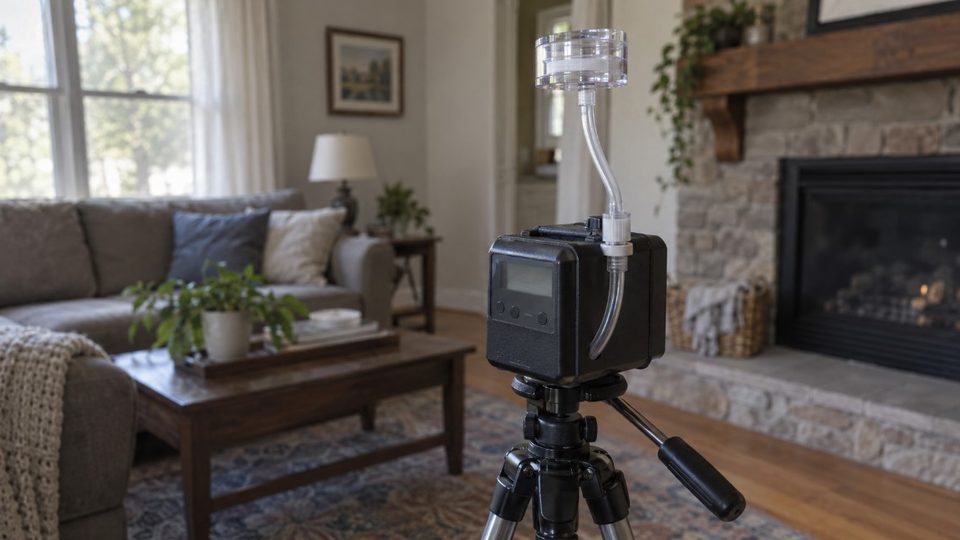
The standard method. A calibrated pump draws a known volume of air — typically 75 to 150 litres — through a cassette containing an adhesive slide. Everything airborne impacts and sticks to the slide, which is sent to the laboratory and read under a microscope. The result is reported as spores per cubic metre, broken out by genus.
Air sampling captures both viable and non-viable spores, which matters because dead spores still carry the proteins that trigger allergic response. Its weakness is that it is a snapshot: it measures a few minutes of air in one location. Spore concentrations vary enormously with activity, with HVAC operation, and with the time of day. A sample taken in a still room with the system off can read low even in a contaminated building — which is why sampling protocol matters as much as the sample itself.
The outdoor control sample — non-negotiable
Mold is a normal component of outdoor air everywhere on earth, and in a wooded Pennsylvania county it is abundant. Outdoor spore counts in Montgomery County swing seasonally by more than an order of magnitude: high in late summer and autumn when Cladosporium and Alternaria are sporulating off leaf litter, far lower over hard winter and under snow cover. An indoor reading of 900 spores per cubic metre might be unremarkable in September and a genuine red flag in February.
This is why every legitimate air sampling job includes at least one outdoor control taken the same day, in the same weather. Indoor results are interpreted relative to that control. An indoor sample that is broadly similar in both count and species profile to outdoors suggests normal fungal ecology. An indoor sample showing species that are scarce or absent outdoors, or showing far higher counts of a particular genus, indicates an indoor amplification source. A report without an outdoor control is close to uninterpretable. If you are handed one, ask why.
Surface sampling — swab and tape lift
A sterile swab or a clear adhesive tape lift taken directly from visible growth. This is the most reliable way to identify what a specific patch actually is. It does not tell you anything about air quality, and there is no meaningful “normal” count for a surface — growth on a surface is simply present or not. Surface sampling is what you use when you need to name the organism: for a landlord dispute, an insurance claim, or a physician who has specifically asked.
Wall cavity sampling
A variation on air sampling in which a small port is made in the drywall and the sampling probe is inserted into the cavity itself. This is how you test the air inside a closed assembly — particularly valuable in a finished basement where the suspicion is growth on the back of the drywall. It answers the question a room air sample often cannot, because the wall cavity may be substantially sealed from the room.
Bulk sampling
A physical piece of the material — a section of drywall, a plug of insulation, a carpet fibre sample — sent to the laboratory. Used where the extent of contamination within a material matters, or where a definitive answer is needed for legal purposes.
Reading a Laboratory Report Without Being Frightened by It
Laboratory reports are written for professionals and land on homeowners' kitchen tables looking alarming. A few points make them far easier to read.
| What you see | What it usually means |
|---|---|
| Cladosporium present indoors and outdoors at similar counts | The most common outdoor mold in temperate climates. Similar in and out is normal ecology, not a finding. |
| Penicillium/Aspergillus group elevated indoors | The most common genuine indoor amplification signal in this region. The laboratory reports them as one group because their spores are not reliably distinguishable by microscopy. Strongly associated with damp indoor materials. |
| Stachybotrys detected at any count | Significant. This organism needs prolonged saturation of cellulose material to grow, so its presence indicates a sustained water problem. Its spores are heavy and sticky and do not travel far in air, so even a low air count suggests a source nearby. |
| Chaetomium detected | Another water-damage indicator. Same implication: sustained wetting of cellulose material, typically wet drywall. |
| Basidiospores elevated | Usually outdoor origin (mushrooms and wood-decay fungi). Elevated indoors can point to wood rot in a crawl space or structural timber. |
| “Hyphal fragments” noted | Broken pieces of fungal structure. Their presence suggests disturbance of active growth somewhere in the sampled air. |
| Total count lower indoors than outdoors | Generally reassuring — but only if the species profile also matches. Check both columns, not just the totals. |
The settle-plate kits sold in hardware stores will grow colonies from any indoor air in any building on earth, because normal air contains viable spores. They have no calibrated volume, no outdoor control, and no way to distinguish normal background from amplification. Their output is a plate with colonies on it, which is frightening and meaningless. If the reason you are testing is that you need a document someone else will act on, the only useful test is one taken with a calibrated pump and analysed by an accredited laboratory.
When Testing Is Genuinely Worth Paying For
- Post-remediation clearance. The single strongest use case. Testing after the work is the only objective proof it succeeded. This must be performed by a party independent of the remediation contractor — see post-remediation verification.
- Insurance claims. Adjusters want laboratory data. Pre-remediation sampling with an outdoor control, tied to dated photographs and moisture readings, is what supports a claim.
- Real estate transactions. Either as a buyer establishing condition before closing, or as a seller documenting that a previously remediated problem was properly resolved.
- Landlord and tenant disputes. In Pennsylvania, the implied warranty of habitability is the legal mechanism, and laboratory documentation is what converts a complaint into evidence.
- Odour with no visible source. Where inspection has narrowed the location but not confirmed it, cavity sampling can settle the question before you cut anything open.
- A physician has specifically requested species identification. Uncommon, but it happens with immunocompromised patients.
When Testing Is Usually a Waste of Money
If you can see the mold, you know where the water came from, and you are going to remediate regardless — testing before the work rarely changes anything. You already know there is mold; a number confirming it does not alter the scope. Spend the money on the inspection that finds the water source and on clearance testing afterwards, which actually proves something. Any contractor who insists on extensive pre-testing before a straightforward, visible, well-understood problem is adding cost without adding information.
Frequently Asked Questions
In the Greater Philadelphia market, a basic air sampling package — typically two indoor samples plus one outdoor control, with laboratory analysis and a written interpretation — generally falls in the $300 to $600 range. Additional air samples usually run $75 to $150 each. Surface swabs or tape lifts are commonly $50 to $125 per sample. A comprehensive inspection combined with a multi-sample testing package typically runs $500 to $900. These are general market ranges for planning purposes, not quotes. Call (610) 702-8235 and a specialist will tell you what is reasonable for your specific situation.
Standard turnaround for spore trap analysis is two to five business days from when the laboratory receives the samples. Most accredited laboratories offer next-day or same-day rush analysis for an additional fee, usually somewhere between fifty and a hundred percent of the standard cost. Culturable analysis — growing the sample to identify species more precisely — takes considerably longer, typically seven to fourteen days, because the organisms have to actually grow.
For pre-remediation assessment, it is common and generally acceptable. For post-remediation clearance testing, no — and this matters a great deal. A contractor testing their own work has an obvious financial interest in a passing result. The industry standard of care, and every serious protocol, calls for clearance sampling to be performed by an independent third party. Any contractor who resists this or bundles their own clearance test into the price should be treated with real caution. It costs a few hundred dollars to have it done independently and it is the only document that proves the job worked.
Not with any precision. Certain organisms give indirect clues — Stachybotrys generally requires weeks of sustained saturation to establish, so its presence argues against a problem that started last Tuesday. But there is no laboratory method that dates a colony. Where timeline matters, as it often does in insurance and litigation, the evidence comes from building forensics rather than microbiology: staining patterns, material degradation, corrosion, and documented weather or plumbing events.
Yes. Look for a laboratory accredited by the AIHA Laboratory Accreditation Programs, specifically under the Environmental Microbiology Laboratory Accreditation Program (EMLAP). Accreditation means the laboratory participates in external proficiency testing and its analysts are checked against known samples. Given that Pennsylvania does not regulate this industry at all, the laboratory's accreditation is one of the few genuinely independent quality signals available to you. Ask which laboratory will be used, and confirm it before samples are taken.