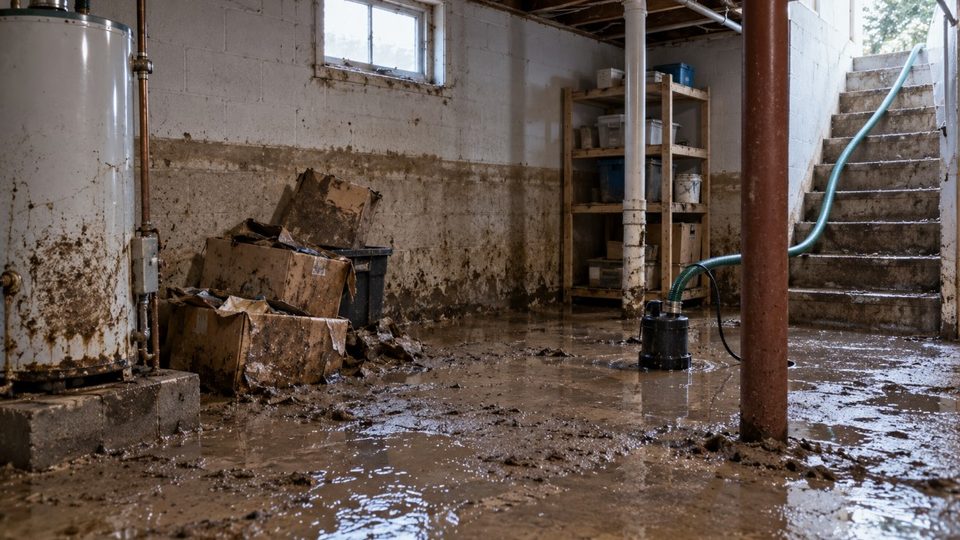
Water Damage and Mold Are the Same Project at Different Stages
They are usually sold as two services and they are really one continuum. Water enters a building; if it is removed and the structure is dried within roughly 24 to 48 hours, it stays a water damage job. If it is not, fungal colonies establish on the wet material and it becomes a mold remediation job, typically at two to four times the cost. Nothing else about the event changes. Only the clock.
That is the framing worth holding on to when you are standing in a wet basement deciding whether to call someone. The question is not “is this bad enough to need a professional”. The question is “can this be dried inside two days”.
Water Damage in the Schuylkill Valley
Montgomery County has a specific water damage profile, shaped by its rivers and its housing stock.
Riverine flooding: the Schuylkill and the Perkiomen
The Schuylkill River runs the length of the county, and the boroughs along it — Norristown, Bridgeport, Conshohocken — have flood-exposed districts that have been inundated repeatedly. The gauge at Norristown has flood stage at 13 feet. Its all-time record crest is 25.10 feet, set during Hurricane Agnes in June 1972. Hurricane Floyd brought it to 22 feet in September 1999. On 1 September 2021 the remnants of Hurricane Ida produced catastrophic flooding across the region, with the Schuylkill reaching major flood stage and widespread damage in Norristown, Bridgeport and Conshohocken; the USGS recorded new peak streamflows of record at numerous gauges across southeastern Pennsylvania during that event.
The Perkiomen Creek, which joins the Schuylkill near Oaks, drains a large watershed through Collegeville and the surrounding communities and rises very rapidly in heavy rain. Ida produced record flooding along it as well.
Riverine floodwater is Category 3 — black water. It has passed over roads, through storm drains, past fuel tanks and frequently through sanitary sewer systems. Everything porous that it contacted comes out: drywall, insulation, carpet, pad, cabinetry, and anything else that absorbed it. This is not a judgment call and any contractor suggesting otherwise is cutting a corner that will cost you later.
Sump pump failure
The most frequent single cause of basement water in this county, and it happens at the worst possible moment because pumps fail under load during exactly the storms that require them. Common failure modes: a float switch jammed against the pit wall or a piece of debris; a check valve that has failed, letting the discharge column run back into the pit so the pump cycles continuously until it burns out; a seized motor at the end of its service life; a frozen or blocked discharge line; and simple power loss during a storm.
The last of these is worth dwelling on. A mains-powered sump pump is useless in a power cut, and in this region the power cuts and the heavy rain arrive together. A battery backup pump or a water-powered backup is one of the highest-value few-hundred-dollar purchases available to a Montgomery County homeowner with a finished basement.
Frozen and burst pipes
A genuine seasonal pattern here. Pipes freeze in unheated or poorly insulated locations: garage walls, crawl spaces, exterior walls on the north side, unheated additions, and vacation-empty houses with the thermostat set too low. Water expands as it freezes and splits the pipe, but the discharge usually does not begin until the thaw — which is why the damage frequently appears the day after a cold snap breaks, sometimes while nobody is home.
Ageing supply and drain systems
The older housing stock of Norristown, Bridgeport, Conshohocken and the pre-war Main Line commonly retains original galvanised steel supply piping and cast-iron drain stacks. Galvanised pipe corrodes internally, loses bore, and eventually perforates; cast-iron stacks corrode at the base of the run and leak into cellars, often for years before discovery. Polybutylene supply piping, installed in some homes built between roughly 1978 and 1995, is another known failure risk.
Water Categories — What Determines How Much Comes Out
| Category | Sources | What happens to materials |
|---|---|---|
| Cat 1 Clean water | Supply line, water heater, rainwater direct from above, melting ice | Most materials salvageable if dried within 48 hours. Carpet and pad often saved. |
| Cat 2 Grey water | Washing machine or dishwasher discharge, toilet overflow with urine only, sump pit discharge, waterbed | Pad removed. Carpet may be salvageable with cleaning. Drywall assessed case by case. |
| Cat 3 Black water | Sewage backup, river flooding, any water standing long enough to develop a biological population | All contacted porous material removed. No exceptions. Enhanced PPE and disposal requirements. |
Clean Category 1 water does not stay Category 1. Left standing at room temperature it supports bacterial growth and degrades to Category 2 within roughly 48 hours and toward Category 3 thereafter. A burst supply pipe discovered after a week-long absence is not a clean water loss any more, and the removal threshold changes accordingly. This is another reason the clock matters so much.
The Restoration Sequence
- Make safeElectrical isolation to affected areas, gas check if relevant, structural assessment where a ceiling has taken on water. Saturated drywall ceilings are heavy and do collapse.
- Stop the sourceShut a valve, cap a line, tarp a roof, or get a temporary pump running. Drying while water is still arriving accomplishes nothing.
- ExtractTruck-mounted or portable extraction removes standing water and pulls far more from carpet and pad than any consumer equipment. Every gallon removed mechanically is a gallon that does not have to be evaporated.
- Map the moistureDefine how far the water actually went. It travels along the slab, wicks up drywall, runs inside wall cavities and moves under flooring. The wet area is routinely far larger than the visibly wet area.
- Controlled demolitionBaseboard removed, weep holes drilled at the base of walls, a section of pad lifted, or the lower portion of drywall cut out — so air can reach the cavity. Small and surgical now; full removal later if skipped.
- Structural dryingCommercial LGR dehumidifiers and air movers positioned to a calculated plan, with daily moisture readings logged against target values. Typically three to five days, longer for masonry and hardwood.
- Antimicrobial application where warrantedOn cleaned surfaces in Category 2 and 3 losses, as prevention. Not a substitute for drying and not a substitute for removal.
- Verify and documentFinal moisture readings at target, a complete drying log, and photographic documentation throughout. This is what supports the insurance claim.
Hardwood Floors: The Special Case
Solid hardwood over a wet subfloor is the most commonly mishandled material in residential water loss, and it is worth knowing the basics because the decisions are expensive.
Wood cups when the underside is wetter than the top — the bottom swells and the edges lift. Cupping is not automatically terminal; boards frequently flatten as they equalise. Crowning is the opposite and is often the result of sanding a cupped floor too early: the crown appears once the moisture equalises and the sanded-flat edges are now lower than the centre. The correct approach is specialised drying, often using floor mat systems that pull air through the board assembly from above, followed by an acclimation period of weeks before any decision about sanding. Any contractor proposing to sand a wet floor immediately is about to cost you the floor.
Working With Your Insurer
Notify immediately. Prompt notice is a policy condition, and delay is one of the most common grounds for reduced payment.
Start mitigation at once. Nearly every policy imposes a duty to mitigate further damage. Waiting for an adjuster before drying is not mitigation, and insurers routinely decline the additional damage that accrued in the interval.
Understand what is typically covered in Pennsylvania. Sudden and accidental discharge — a burst pipe, a failed appliance, a storm-damaged roof — is generally covered. Surface flooding from a river or overwhelming rain is not, and requires separate NFIP coverage. Sump pump failure and sewer backup are typically excluded from a standard policy but are widely available as an inexpensive endorsement. Given how common sump failure is in this county, check your declarations page now.
Keep everything. Dated photographs before anything is moved, the moisture map, the daily drying logs, receipts for anything you purchased, an inventory of damaged contents with approximate values, and a record of additional living expenses if you had to leave. Assemble it as you go.
Frequently Asked Questions
Not surface flooding — a river leaving its banks or heavy rain overwhelming the ground. That requires a separate National Flood Insurance Program policy, and it is a genuine consideration for properties in the flood-exposed districts of Norristown, Bridgeport, Conshohocken, Collegeville and Royersford. Standard homeowners policies do cover sudden and accidental water discharge from inside the home: burst pipes, failed water heaters, appliance supply line failures, and rainwater entering through storm damage to the roof. The two most important gaps in Montgomery County are sump pump failure and sewer backup, both commonly excluded and both available as inexpensive endorsements. Read your declarations page now rather than after an event.
Urgent. Sump discharge is Category 2 grey water at best, and mold colonies establish on wet material within 24 to 48 hours. Carpet pad, drywall, fibreglass insulation and the bottom plate of any framing are all absorbing water right now. Call for extraction and drying the same day. While you wait: cut power to the affected area at the breaker if water is anywhere near outlets, photograph everything before you move anything, notify your insurer, and lift what you safely can off the floor. Also find out why the pump failed — if it was a power cut, a battery backup is the fix, and if it was the pump itself, replace it before the next storm rather than after.
Typically three to five days for a straightforward residential loss, though the honest answer is that it takes as long as the meter says. Masonry and concrete hold water and release it slowly, so basements generally run longer than above-grade rooms. Hardwood flooring often needs seven to fourteen days of specialised drying. Plaster on wood lath is slower than drywall. The important thing is that drying is measured rather than scheduled: a contractor who pulls equipment on day three because day three was the plan, without confirming the readings, is leaving you with wet framing behind new drywall. Ask to see the daily log.
Often, if the response is fast and the drying is done properly. Solid hardwood that has cupped is frequently recoverable with specialised drying — floor mat systems that pull air through the board assembly — followed by weeks of acclimation before any decision about refinishing. The mistake that destroys otherwise salvageable floors is sanding too early: sanding a cupped floor flat produces crowning once the wood equalises, and crowning usually cannot be fixed without replacement. Engineered hardwood is less forgiving because delamination of the layers is generally permanent. Laminate almost never survives, as the fibreboard core swells irreversibly.
It is genuinely possible, and we still take calls about it. The scale of the 1 September 2021 event overwhelmed contractor capacity across the region for months, and a great deal of work in that period was done fast and incompletely — visible water removed, surfaces cleaned, drywall replaced, but wall cavities never properly dried and no clearance testing performed. Riverine floodwater is Category 3, which means all contacted porous material should have been removed; where that was not done, contaminated material was simply covered over. If your property was flooded then and you have any persistent musty odour, staining at the base of walls, or unexplained respiratory symptoms, an inspection with moisture metering and cavity sampling is worth doing. It is also worth doing before you sell, because it will come up.