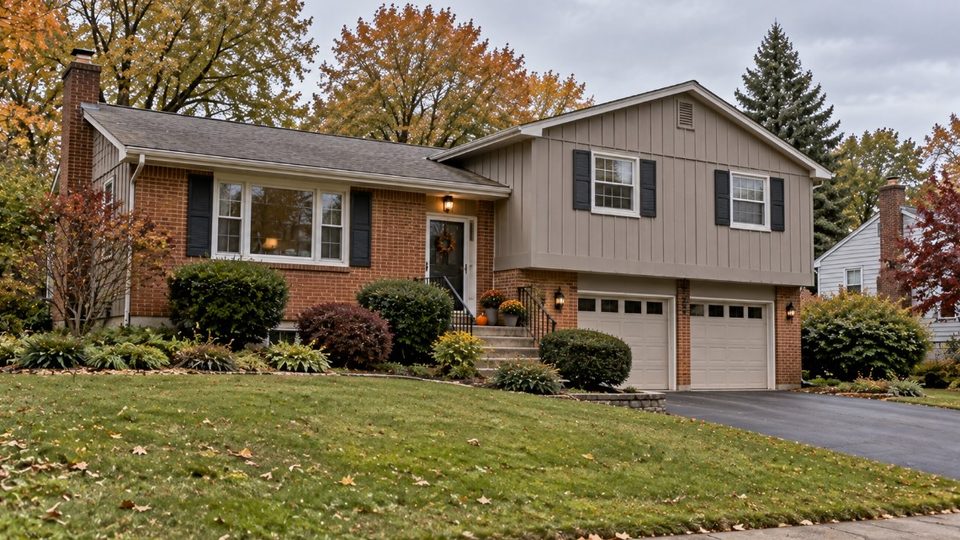
Suburban Montgomery County, Built Mostly Since 1960
Blue Bell is an unincorporated community in Whitpain Township, Montgomery County, in the 19422 ZIP. It is predominantly a postwar and later suburban community — single-family colonials, ranches and split-levels from the 1960s and 1970s, substantial 1980s and 1990s subdivision development, and newer construction including townhomes and active-adult communities.
There are older farmhouse and stone properties scattered through the township, and they follow the historic-masonry rules described on our Gulph Mills page. But the overwhelming majority of mold work in Blue Bell is in houses built since 1960, and that means one thing above all others.
The Finished Basement Is the Whole Story Here
Blue Bell’s housing stock is concentrated in exactly the decades when the standard way to finish a basement was to erect a wood stud wall directly against the foundation, install fiberglass batt insulation between the studs, hang paper-faced drywall over it, and put carpet on the slab.
This was normal practice, it was code-compliant, and every element of it is wrong for this climate:
- The buried foundation wall sits at roughly 52 to 58°F year round. Summer dew points here run in the mid-60s to low 70s°F.
- Fiberglass does not stop air or vapour — it is a filter. Humid air moves straight through it to the cold masonry behind.
- Once damp, fiberglass holds that moisture against the back of the drywall and loses most of its insulating value.
- Drywall paper facing is cellulose — close to an ideal fungal substrate in a dark, still cavity.
- The entire assembly is invisible. Growth runs on the concealed face for years before it produces an odour in the room.
The finished side looks perfect. The back of the drywall is black. This is the single most common call we take from Blue Bell, and it is why a persistent musty smell with no visible source should be investigated here rather than dismissed.
The Other Failure Points in This Housing
- The rim joistBare in pre-1980 houses, holding an unsealed fiberglass batt in later ones. Coldest wood in the building in winter, prime condensation surface in summer, essentially never inspected. Pull back a batt and look.
- Vented crawl spacesWhere parts of a house sit over a crawl space rather than a full basement. Vents import humid summer air into a cool space and condense it onto the floor framing. The fix is to close and condition the space, which is the opposite of conventional wisdom. See crawl space mold removal.
- Bath fansFrequently undersized, frequently wired to the light switch so they never run long enough, and in some cases discharging into the attic. Twenty minutes of run time after a shower is what is needed — realistically a timer switch.
- Attached garages and rooms above themUnder-insulated and poorly air-sealed floor assemblies produce the coldest interior surfaces in the house. Growth in the corner of a bedroom over a garage is a common and well-understood complaint.
- Upper-floor and attic air handlersA blocked condensate drain means the pan overflows through the ceiling below. A float safety switch costs very little and prevents it.
- Settled gradingGround that sloped away from the foundation in 1975 has frequently settled to slope toward it by now. One of the cheapest and most commonly overlooked root causes.
- Ice dammingFreeze-thaw cycling plus heat loss through the ceiling plane. Water backs up under the shingles at the eave and soaks the top plate and wall cavity, typically not staining visibly until the following summer.
How to Rebuild a Basement So It Does Not Fail Again
If you are remediating a failed finished basement in Blue Bell, this is the practical payoff:
Rigid foam board directly against the masonry, adhered or mechanically fastened with taped seams. This raises the interior surface temperature above the dew point and is itself unaffected by moisture. It is the critical layer and the one most often omitted. Frame in front of the foam, not against the wall. Use mineral wool rather than fiberglass if additional insulation is wanted — it is hydrophobic and does not support growth. Use paperless or fibreglass-mat-faced gypsum board, which removes the cellulose entirely. No carpet pad on the slab — a floating floor over a dimpled membrane, or sealed and finished concrete. And permanent dehumidification, correctly sized, plumbed to the sump or a floor drain, set to 45 to 50 percent.
That specification costs roughly fifteen to twenty percent more than rebuilding it the way it was. It is the difference between a basement that lasts and one you tear out again in a decade.
Radon
Whitpain Township sits within the area of elevated radon potential across Montgomery County, where roughly 40 percent of Pennsylvania homes tested exceed the EPA action level of 4 pCi/L. Radon and moisture enter through the same pathways — the slab-to-wall joint, slab cracks, the sump pit. If you are already opening up a basement, it is the sensible moment to test. Unlike mold, radon mitigation is regulated in Pennsylvania: the DEP certifies testers and mitigators, so there is an actual credential to verify.
What We Get Called About Most in Blue Bell
Ranked by how often it comes up, and tied to the buildings that are actually here rather than to mold in general.
- Finished basements — almost everythingBlue Bell's housing is concentrated in exactly the decades when basements were finished with a stud wall against the foundation, fiberglass batts and paper-faced drywall. One assembly accounts for most of the work here.
- Vented crawl spaces under parts of housesWhere sections sit over a crawl space rather than a full basement, the vents import humid summer air and condense it onto the floor framing.
- Rooms over unconditioned garagesUnder-insulated floor assemblies producing the coldest interior surface in the house, and growth in the corner of the room above.
- Rim joists holding unsealed fiberglassStandard in this era and essentially never inspected. High-value work that pays back in heating cost as well as moisture control.
- Settled grading after decadesGround that sloped away when the house was built now falls toward it. Free to identify and cheap to correct.
Neighborhoods and Sections We Cover in Blue Bell
Mold Services Available in Blue Bell
Mold Inspection
Thermal imaging and moisture metering to locate the source before anything is opened up.
DetailsBasement Mold Removal
The dominant mold problem in Blue Bell — finished walls, stone foundations and sump failures.
DetailsBlack Mold Removal
Full containment for water-damage indicator species, plus finding the sustained water source.
DetailsAttic Mold Removal
Sheathing and rafter growth traced back to ventilation, bath fans or ice damming.
DetailsWater Damage & Flood Mold
Burst pipes, sump failures and flooding — the 24 to 48 hour response window.
DetailsClearance Testing
Independent verification by a hygienist who did not perform the remediation.
DetailsWhat Mold Work Costs in Blue Bell
General market ranges for the Greater Philadelphia area, listed for the situations that actually come up in Blue Bell. These are planning figures rather than quotes — nobody can price a job they have not seen, and what moves a number most is the size of the wet area rather than the stained area. The full cost guide explains what drives each one up or down.
| Work | Typical range | Notes |
|---|---|---|
| Mold inspection with thermal imaging and moisture metering | $300–$700 | Most projects should start here |
| Small contained area — one wall section, a closet, behind a water heater | $600–$1,800 | Under roughly 10–30 sq ft |
| Single room | $1,500–$4,500 | Containment, removal, drying, clearance |
| Finished basement — wall removal, drying, clearance | $5,000–$15,000 | Excluding reconstruction |
| Crawl space remediation with full encapsulation | $5,000–$15,000 | Vapour barrier, sealed vents, wall insulation, dehumidifier |
| Independent post-remediation clearance testing | $350–$700 | The only stage that produces evidence rather than assurance |
| Reconstruction after remediation | $25–$60 / sq ft | Quote this separately so you can compare bids |
Mold FAQ — Blue Bell, PA
In Blue Bell housing the answer is usually the finished wall assembly. Growth on the concealed back face of the drywall, on the bottom plate, or in the fiberglass produces microbial VOCs — the musty smell — long before anything is visible on the finished side. Confirming it means moisture metering along the bottom plate, a thermal scan of the wall, and usually a small borescope port placed low where a baseboard will cover the repair. If the basement is unfinished, check the rim joist behind the insulation batts, under the stairs, behind stored cardboard, and the underside of the subfloor. Do not dismiss a persistent musty smell because nothing is visible — in this housing stock, invisible is the normal presentation.
General market ranges: a small contained area, roughly $600 to $1,800. A basement wall section with removal, drying and clearance testing, roughly $2,500 to $6,000. A full finished basement gut and remediation, roughly $5,000 to $15,000 excluding reconstruction. Reconstruction on top, typically $25 to $60 per square foot depending on finish level. Crawl space remediation with encapsulation where applicable, roughly $5,000 to $15,000. Inspection roughly $300 to $700. Planning ranges, not quotes.
Because that is the coldest interior surface in the house. The floor assembly over an unconditioned garage is chronically under-insulated and poorly air-sealed in production housing, so the floor and the lower part of the exterior wall in that room run several degrees below the rest of the house — and a corner is colder still because heat is lost in two directions. When indoor humidity is elevated, the coldest surface is where condensation appears first. The fix has two halves: bring the indoor humidity down through ventilation, and raise the surface temperature by properly insulating and air-sealing the garage ceiling assembly. Do both and it resolves; do only one and it improves.
If it is a vented crawl space with a bare earth floor, then almost certainly yes — but as a complete job rather than by closing the vents alone. Vented crawl spaces fail in this climate: from June to September those vents import humid air into a cool space and condense it onto your floor framing. The sequence that works is to correct any bulk water entry, remove contaminated insulation, clean and dry the framing, seal a reinforced vapour barrier over the earth and up the walls, seal the vents and penetrations, insulate the perimeter wall rather than the floor above, and then dehumidify or condition the space. Closing the vents without the vapour barrier and dehumidification makes matters worse.
For active water intrusion — a failed sump, a burst pipe, an overflowing condensate pan — someone is available around the clock and same-day attendance is normal. For non-urgent inspections, typically within a few business days. Late summer and the weeks after any significant storm are the busiest periods in this region. Before booking anything, it is worth calling the line: describing the seasonal pattern and the age of the house is frequently enough for a specialist to tell you whether an inspection is warranted at all, and that conversation is free.