Call (610) 702-8235. The line is answered 24 hours a day. Before you call, if it is safe to do so: shut off the water at the source or at the main, and switch off electricity to any affected area at the breaker. Do not enter standing water in a room with live outlets or a submerged appliance.
If there is sewage involved, if water is near an electrical panel, or if you smell gas — leave the building and call the utility or 911 first. No amount of property damage is worth an electrocution.
Why the First 48 Hours Decide Everything
There is a genuine deadline in water damage work, and it is not a sales tactic. Mold colonies become established on wet cellulose material in roughly 24 to 48 hours at normal indoor temperatures, and visible growth typically appears within three to seven days. Drywall paper, carpet pad, fibreglass batt facing, cardboard and wood are all available substrate, and every one of them is present in a typical Montgomery County basement.
What that means practically is that the same water event has two completely different price tags depending on how fast it is dried:
| Response time | What the job becomes |
|---|---|
| Within 24 hours | Water extraction and structural drying. Most materials salvageable. No containment required, no clearance testing, no mold work at all. |
| 24–72 hours | Drying plus preventive antimicrobial treatment. Porous materials on the margin. Some removal likely. |
| 3–7 days | Now a mold remediation project. Containment, removal of porous materials, clearance testing. |
| Beyond a week | Full remediation with significant demolition. Often two to four times the cost of the same event dried immediately. |
This is why the honest advice after any significant water intrusion is to get drying equipment in immediately, even if the situation looks manageable. Drying a floor that turns out to have been fine is a minor cost. Not drying a wall cavity that was wet is a major one.
What Counts as an Emergency in This Region
- Sump pump failure. The most common single emergency call in Montgomery County. Pumps fail during exactly the storms that need them, and a basement can take on several inches overnight. The common causes are a stuck float, a failed check valve allowing backflow, a seized motor, and power loss during the storm — which is why a battery or water-powered backup is worth having in this region.
- Burst supply line. A supply pipe under pressure discharges continuously until someone shuts a valve. A quarter-inch line can deliver hundreds of gallons in an hour. Winter freeze-ups in unheated spaces, garage walls and crawl spaces are a seasonal pattern here.
- Water heater tank failure. Tanks fail at the bottom seam and release their full contents, then keep refilling and releasing until the supply is shut. A 50-gallon tank in an unfinished basement with a floor drain is an inconvenience; the same tank in a finished basement is a major loss.
- Appliance and supply hose failure. Washing machine hoses, dishwasher supply lines, refrigerator ice maker lines. Rubber hoses degrade; braided stainless is the sensible replacement.
- Sewage backup. A category of its own. Sewage is biologically hazardous and requires different protective equipment, different disposal and a far more aggressive removal threshold — essentially all porous material that contacted it comes out. Do not attempt to clean this yourself.
- Roof failure or storm damage. Wind damage, a tree strike, or a failed flat roof during heavy rain.
- Riverine flooding. The Schuylkill and the Perkiomen. Norristown, Bridgeport, Conshohocken, Collegeville and Royersford all have flood-exposed areas, and the September 2021 Ida event demonstrated how quickly that can escalate. See water damage and flood mold.
- Ice dam water entry. Mid-winter water appearing at the top of an exterior wall or on an upstairs ceiling during a thaw.
What to Do in the First Hour
- Make it safe firstElectricity off to affected areas at the breaker if water is anywhere near outlets, appliances or the panel. Do not stand in water to reach a breaker — if the panel is in the wet area, call the utility. Gas smell means leave and call from outside.
- Stop the waterFixture shut-off valve if you can identify it, otherwise the main. Know where your main shut-off is before you need it — for most homes here it is on the street side of the basement wall near the meter.
- Photograph and video everythingBefore you move anything at all. Wide shots for context, close shots for detail, and capture the water level on walls and furniture. This is the single most valuable thing you can do for an insurance claim and it takes three minutes.
- Call your insurer and open a claimDo it immediately, even if you are unsure whether it is covered. Most policies require prompt notice, and most also require you to take reasonable steps to prevent further damage — which means calling for drying is not just permitted, it is expected.
- Call for emergency extraction and drying(610) 702-8235, answered 24/7. The equipment matters more than anything you can do by hand.
- Move what you can, safelyLift furniture onto blocks or foil, get rugs up off wet floors, and move documents, photographs and electronics out. Do not lift anything heavy or wet on your own.
- Do not use a household vacuumA domestic vacuum is not rated for water and using one is an electrocution risk. A wet-dry shop vacuum is fine for small volumes.
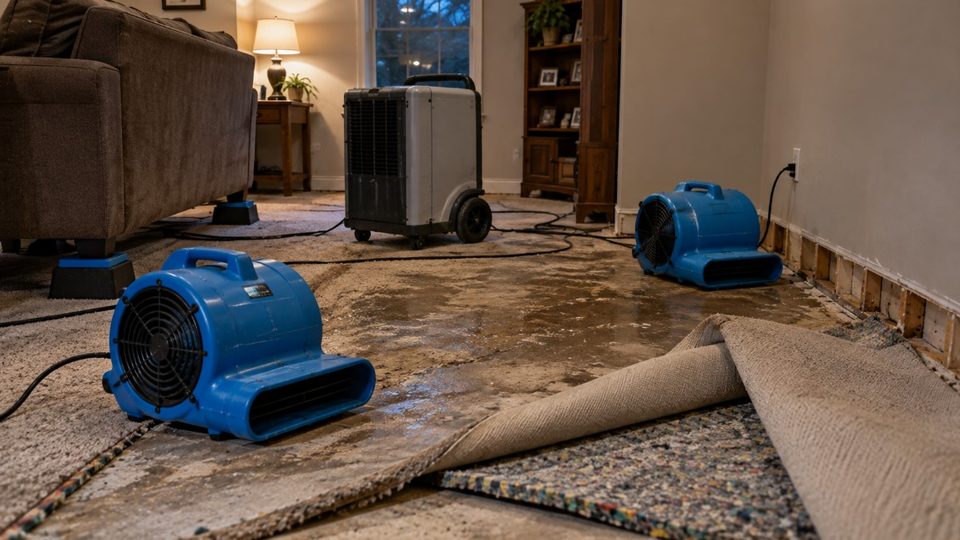
- Do not point fans at it and walk awayAir movement without dehumidification simply redistributes the moisture into other materials and other rooms. Drying requires both, and the dehumidification is the part that actually removes water from the building.
What Emergency Response Actually Does
Extraction. Truck-mounted or portable extraction units remove standing water and pull a great deal more out of carpet, pad and porous flooring than any consumer equipment. Volume removed mechanically is volume that does not have to be evaporated, which is the expensive, slow part.
Assessment and moisture mapping. Establishing how far the water actually travelled. Water moves along the top of a slab, wicks up drywall by capillary action, runs inside wall cavities and travels under flooring. The wet area is routinely much larger than the visibly wet area, and this is what determines the drying plan.
Controlled demolition where required. Removing baseboard, drilling weep holes at the base of walls, lifting a section of carpet pad, or removing the lower portion of drywall so that the cavity can be dried. Small, surgical, and much cheaper than the full removal that becomes necessary if the cavity is left wet.
Structural drying. Commercial dehumidifiers and air movers, sized and positioned to a calculated plan rather than scattered around. Daily moisture readings are logged against target values. This is the phase that takes days and that homeowners are most tempted to cut short.
Monitoring to documented completion. Drying stops when the meter says the materials have reached target, not when the calendar says three days. Ask for the drying log — a legitimate operation produces one automatically.
Category 1 — clean water. Supply line, water heater, rainwater. Most materials salvageable if dried fast.
Category 2 — grey water. Washing machine or dishwasher discharge, toilet overflow without solids, sump discharge. Carpet pad out, carpet may be salvageable, drywall case by case.
Category 3 — black water. Sewage, river flooding, any water that has been standing long enough to have grown a biological population. All porous material that contacted it is removed, no exceptions. Note that Category 1 water degrades to Category 2 and then 3 over time — clean water left standing for several days is no longer clean water.
Insurance: Do Not Wait for the Adjuster to Start Drying
This is the point that costs Pennsylvania homeowners the most money. Nearly every policy contains a duty to mitigate — an obligation to take reasonable steps to prevent further damage after a loss. Waiting three days for an adjuster to attend before you start drying is not mitigation, and insurers will frequently decline the additional damage that accrued in the meantime.
The correct sequence is: photograph everything, notify the insurer immediately, and begin emergency drying at once. Keep every receipt, keep the drying logs, and keep the moisture readings. A restoration contractor who works with claims routinely will document the loss in the format adjusters expect, which materially improves outcomes.
Frequently Asked Questions
Colonies establish on wet cellulose material in roughly 24 to 48 hours at normal indoor temperatures, and visible growth generally appears within three to seven days. That is not a marketing figure — it reflects how fast common indoor fungi germinate and establish on available substrate. The practical implication is that whether a water event becomes a mold job is decided in the first two days, by whether the materials were dried or not. A basement that is thoroughly dried within 24 hours usually never becomes a mold project at all.
Probably, and this is the most common expensive mistake. A surface that feels dry to the hand tells you nothing about the moisture content inside the material. Water wicks up drywall by capillary action, runs along the top of the slab under flooring, soaks into the bottom plate of framing, and saturates insulation inside wall cavities where there is no airflow at all. Those materials can be at 30 percent moisture content behind a wall that looks and feels perfectly normal. A moisture meter survey takes under an hour and is inexpensive. If the readings are clear, you have peace of mind. If they are not, you have caught it inside the window where drying still works.
Typically yes for sudden and accidental events — a burst pipe, a failed water heater, an appliance supply line, storm damage to the roof. Typically no for surface flooding from a river or heavy rain, which requires separate NFIP flood insurance, and typically no for damage from long-term seepage or deferred maintenance. Sump pump failure and sewer backup are the important middle case: both are commonly excluded from a standard homeowners policy and both are commonly available as an inexpensive endorsement. Given how frequent sump failures are in Montgomery County, it is worth checking your declarations page now rather than finding out afterwards.
For a genuinely small, contained spill on a hard surface, yes. For anything that has soaked carpet, reached drywall, or run into a wall cavity, consumer equipment is not adequate — and the problem is not effort, it is capacity and placement. Commercial low-grain refrigerant dehumidifiers remove several times the water per day that a consumer unit does, air movers are positioned to a calculated plan rather than pointed at the wet patch, and the whole thing is monitored with meters against targets. The most common DIY failure is running fans without adequate dehumidification, which evaporates water out of the floor and deposits it into the drywall, the ceiling and the room next door.
General market ranges for this area: emergency extraction and initial setup, roughly $500 to $1,500. Structural drying for a typical basement over three to five days, roughly $1,500 to $5,000. Larger or multi-room events, commonly $4,000 to $15,000. Sewage (Category 3) losses are considerably higher because of the protective equipment, disposal requirements and the far more aggressive removal threshold. Set against those figures, the cost of not drying promptly is typically two to four times as much, because the job becomes a remediation with demolition. Most of this is claimable where the cause is covered, which is why immediate notification matters.