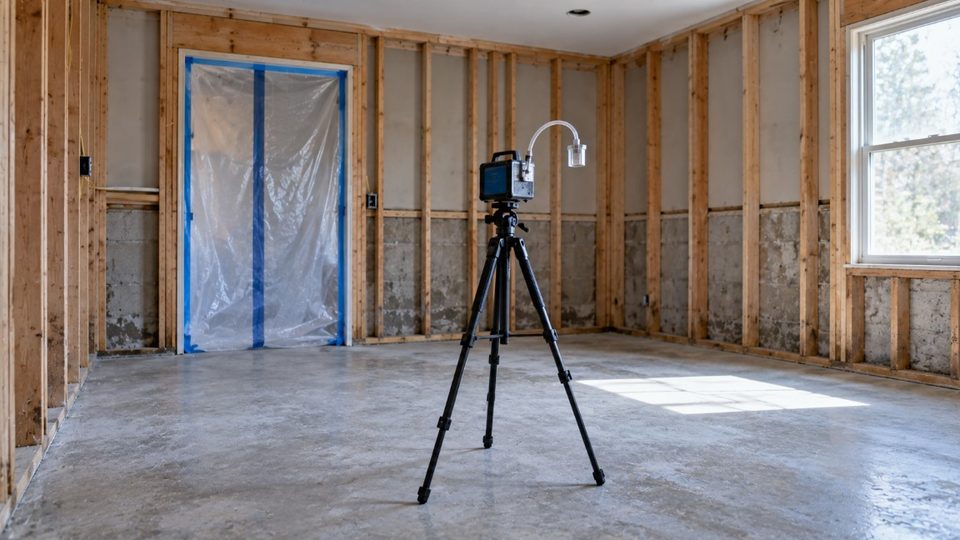
The Only Stage That Produces Proof
Every other part of a mold project is something a contractor tells you they did. Post-remediation verification is the one part that produces independent evidence. It is also, consistently, the stage most often left out — because it costs a few hundred dollars, because it creates a document that can fail, and because a contractor who has already been paid has no incentive to commission one.
If you take one thing from this page: the clearance test must be performed by someone with no financial relationship to the remediation. A contractor testing their own work is grading their own homework, and in a state with no licensing whatsoever, that independence is close to the only external check available to you.
Two things go wrong when clearance is an afterthought. First, without a pre-remediation baseline sample there is nothing meaningful to compare the result against. Second, the clearance criteria — what counts as a pass — should be agreed in writing before anyone knows the result. Criteria negotiated after a disappointing number are not criteria. Put the clearance provider, the criteria and who pays into the scope of work at the start.
What Verification Actually Consists Of
A proper clearance is not just an air sample. It has three components, and a report that contains only the third is incomplete.
1. Visual inspection
Performed first, and it is a pass/fail gate on its own. The assessor confirms: all contaminated material identified in the scope has actually been removed; surfaces are visibly clean with no settled dust or debris; there is no remaining visible growth; the work area has been properly cleaned rather than merely emptied; and the containment is still intact at the time of inspection. If the visual inspection fails, sampling does not proceed. There is no point measuring the air in a room that still has debris in it.
2. Moisture verification
Moisture readings across the affected materials, confirming that the structure has been dried to target — generally at or below roughly 16% moisture content in wood framing, and comparable to unaffected reference areas elsewhere in the building. This is the component most often skipped, and it is arguably the most important predictor of whether the problem returns. A space can pass an air test while the framing behind it is still wet.
3. Air and surface sampling
Air samples taken inside the remediated area, compared against an outdoor control taken the same day and usually against an unaffected indoor reference area. Surface samples where specifically warranted. The comparison is what matters: the objective is for the remediated space to be indistinguishable from a normal indoor environment, not to achieve zero, which is not a thing that exists.
An important procedural point: sampling should ideally be performed under aggressive conditions, meaning the air in the space is agitated with a fan before and during sampling to lift settled material. A passive sample in a still room that nobody has entered for two days can pass while a genuinely contaminated space still holds settled spores that will become airborne the moment the room is used again.
What Counts as a Pass
There is no federal numerical standard, so the criteria are established by convention and by the agreement made at the start of the project. In practice a clearance is generally considered passed when all of the following hold:
- The visual inspection is clean — no remaining growth, debris or unremoved material.
- Moisture content in the affected materials has reached target and matches unaffected reference areas.
- Total indoor spore counts are at or below the outdoor control, or comparable to an unaffected indoor reference area.
- The species profile indoors resembles outdoors. This matters as much as the total. An indoor count that is numerically low but dominated by a genus scarce outdoors still indicates an indoor source.
- Water damage indicator species — Stachybotrys and Chaetomium in particular — are absent or at trace levels consistent with the outdoor sample.
- No elevated hyphal fragments, which would suggest disturbed growth remaining in the space.
If It Fails
A failed clearance is not a disaster; it is the system working. It means the test caught something that would otherwise have been sealed behind new drywall.
Common reasons: insufficient final cleaning, with settled dust left on horizontal surfaces; a missed area of contamination outside the scoped boundary; containment breached during the work, contaminating an adjacent area; material still wet; or a source that was never identified in the first place, still actively growing.
Who pays for the retest is the question to settle in the contract, before work begins. Reasonable practice, and what a good contractor will agree to, is that if the failure is attributable to the remediation work, the contractor bears the cost of the additional cleaning and the retest. Get that in writing. It is one sentence and it removes the single most common source of dispute at the end of these projects.
What the Report Should Contain
| Element | Why it matters |
|---|---|
| Scope and date of the remediation being verified | Ties the clearance to specific work, which matters for resale and claims |
| Visual inspection findings, with photographs | Documents the condition at the moment of clearance |
| Moisture readings at named locations | Proves the structure was dried, not just cleaned |
| Sample locations, marked on a plan or clearly described | Makes the result reproducible and checkable |
| Outdoor control result from the same day | Without it the indoor numbers cannot be interpreted |
| Full laboratory report, not a summary | You want the species breakdown, not just a total |
| Whether aggressive sampling was used | A passive sample in a still room is a weaker test |
| The assessor's stated criteria and conclusion | An explicit pass or fail against criteria set in advance |
| A statement of independence from the remediation contractor | The whole point of the exercise |
| Laboratory accreditation details | AIHA EMLAP accreditation is the relevant credential |
Keep the Report
This document has a life well beyond the end of the project. It is what you produce when you sell the house and a buyer asks about the water stain a previous inspection noted. It is what supports an insurance claim as evidence the loss was properly resolved. It is what a landlord produces when a tenant raises a habitability complaint about a problem that was already fixed. And if the same problem recurs, it is the baseline that establishes whether the original work was adequate.
Under Pennsylvania’s seller disclosure law, a seller must disclose known material defects. A completed remediation with a passing independent clearance report is very much better to disclose than an undocumented one, and in the Main Line and Montgomery County market it materially reduces the friction a past mold issue creates in a transaction. Scan it and keep it with the deed.
Frequently Asked Questions
They can, and many offer to, and you should decline. A contractor testing their own work has an obvious financial interest in a passing result — a failure means returning to do more work at their own cost. Every serious protocol calls for clearance to be performed by an independent third party, and in Pennsylvania, where nobody is licensed and nobody is inspected, that independence is close to the only external check in the entire process. It costs a few hundred dollars to have it done independently. If a contractor pushes back hard on this, that response is itself informative.
General market ranges for this area: a basic clearance with visual inspection, moisture verification and two to three air samples including the outdoor control, roughly $350 to $700. Larger projects with multiple work areas requiring separate clearance, roughly $600 to $1,500. Commercial projects with zone-by-zone clearance are priced per zone. Against a remediation costing several thousand dollars, this is the least expensive component and the only one that produces evidence. Treat it as part of the project budget from the start rather than an optional extra at the end.
After all remediation and drying is complete but before the containment comes down and before any reconstruction begins. That sequence matters. Testing after the containment is removed means you are measuring a space that is no longer isolated, and testing after new drywall is up means a failure requires tearing out brand new work. The containment stays up until the clearance passes. Practically, the assessor usually attends the day after the drying equipment is shut down, which also allows any settled material to be properly captured by aggressive sampling.
The area is not released. The remediation contractor returns, addresses whatever caused the failure — most commonly insufficient final cleaning or an area of contamination outside the original scope — and the space is retested. Nothing is rebuilt in the meantime. Who pays for the additional work and the retest should have been settled in the contract before work started: reasonable practice is that failures attributable to the remediation work are the contractor's cost. If that is not written down, it becomes a negotiation at the worst possible moment. Ask for it in the scope of work.
Not always, and it would be dishonest to say otherwise. For a genuinely small, contained, straightforward job — a square metre of growth on a bathroom wall from a shower leak you have since fixed — visual verification and moisture confirmation may be proportionate. Clearance testing earns its cost when: the affected area was large; the growth was on or inside porous material; water damage indicator species were involved; the HVAC system was implicated; an insurance claim or landlord dispute is in play; you intend to sell within a few years; or anyone in the household has asthma or is immunocompromised. When in doubt, the few hundred dollars buys you a document you may be glad of in five years.