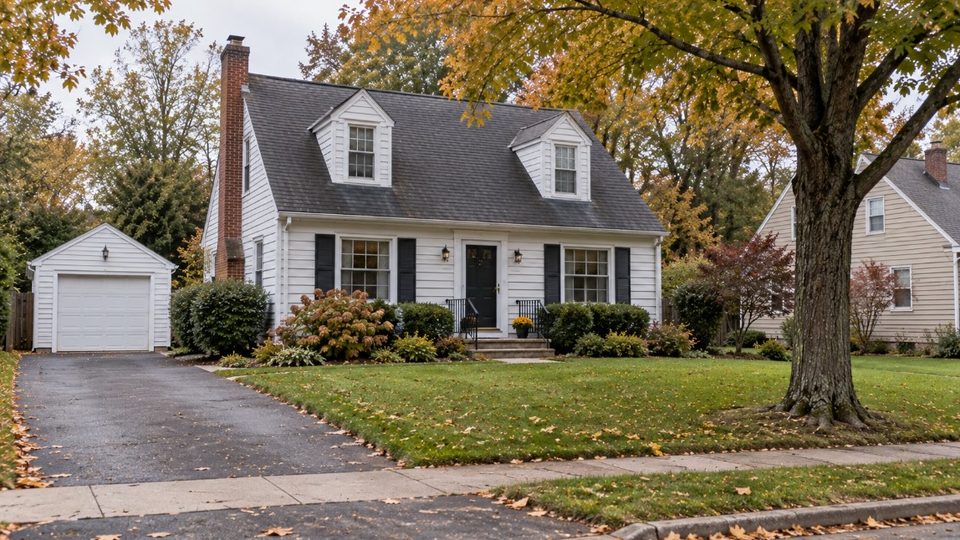
Why Mold Is a Predictable Problem in King of Prussia
King of Prussia is not one housing market. It is at least four, layered on top of each other across three centuries, and each one fails differently. Understanding which layer your house belongs to is the fastest route to knowing where the water is.
The oldest layer is Welsh colonial. The area was settled by Welsh immigrants in the early 1700s and was originally known as Reesville, after the Rees family who owned much of the land. The community took its name from a tavern — the King of Prussia Inn, built as a cottage in 1719 by William and Janet Rees and converted to an inn in 1769, named for Frederick the Great. Scattered stone buildings from that era and the century that followed survive across Upper Merion, and they carry the moisture characteristics of pre-industrial masonry construction.
The second layer is the postwar boom. Between 1950 and 1980, Upper Merion Township gained roughly 650 new residents a year, and the housing built to accommodate that growth — Cape Cods, ranches, split-levels and colonials — still constitutes a very large share of the township’s single-family stock. These are the homes with kneewall attics, original bath fans of doubtful termination, and basements that were never designed to be finished but frequently have been.
The third layer is the 1980s and 1990s suburban expansion, which brought the finished-basement assembly that produces more concealed mold than anything else in this county.
The fourth is current: the King of Prussia Town Center, the Village at Valley Forge, and the substantial apartment and condominium development that has reshaped the area over the last fifteen years. These are tight, well-built envelopes with the opposite problem — not enough air exchange rather than too much water.
The geography underneath all of it
Upper Merion sits on the south bank of the Schuylkill River in the Piedmont, on crystalline bedrock including Wissahickon schist, with the Chester Valley limestone belt running through the southern part of the township. That geology matters in three ways. Shallow rock means many basements were blasted or cut into bedrock, and groundwater moves through fractures rather than soaking through soil, producing seepage that is highly localised and seasonal. The limestone belt brings the region’s solution-weathering characteristics, including sinkhole potential in parts of the Chester Valley. And the whole area sits within a zone of elevated radon potential associated with the Piedmont crystalline geology and the broader Reading Prong — roughly 40 percent of Pennsylvania homes tested exceed the EPA action level, and radon enters through the same slab joints, cracks and sump pits that moisture does.
Surface water runs to the Schuylkill via Gulph Creek, Crow Creek, Trout Creek and Matsunk Creek. None of these produce the kind of regional flooding the Schuylkill itself does in Norristown or Bridgeport, but local flash flooding along the creek corridors and in the low points of older developments is a real and recurring source of basement water.
The Two Seasons That Generate Almost Everything
Whatever the house, the physics are the same, and this is the part most national mold advice gets wrong for this region.
Summer. A buried foundation wall in King of Prussia sits at roughly 52 to 58°F year round. From June through September, regional dew points run in the mid-60s to low 70s°F for weeks at a time. Humid air reaching that wall is already below its dew point and condenses onto the masonry, onto cold copper supply lines, and onto the underside of the first floor. No leak is involved. This is the single largest cause of basement mold in the township and it is the reason opening the basement windows in July makes things worse rather than better.
Winter. The direction reverses. Warm, humid indoor air pushes outward and upward and condenses inside the assemblies — on the back of exterior sheathing, on cold roof decking, and inside the unconditioned kneewall cavities of the township’s many Cape Cods. Add freeze-thaw cycling and around 17 inches of average annual snowfall and you get ice damming, where meltwater refreezes at the cold eave, backs up under the shingles and soaks the top plate and the wall cavity below. Because that happens in February and often does not stain visibly until the following summer, it is one of the most under-diagnosed mold sources in older Upper Merion housing.
King of Prussia Homes, by Era
Pre-1900 stone. Scattered across the township, with a concentration in the older village areas. Fieldstone and schist laid in lime mortar on rubble footings with no damp-proof course — the foundation is permanently in capillary contact with the ground and always has been. These buildings survived two centuries by being vapour-open: water entered the wall and evaporated from the inside face. The damage we see is almost always caused by well-meant modern work — repointing with Portland cement, applying waterproof coatings to the interior face, or framing an insulated stud wall against the stone. All three trap moisture in a wall that has no way of keeping it out.
1940s–1950s Capes and ranches. The postwar boom housing. The defining vulnerability is the kneewall attic — the triangular void behind the upstairs bedroom walls, outside the insulated envelope but connected to the house by every framing gap, wire penetration and an uninsulated access hatch. Warm indoor air leaks in all winter and condenses on cold sheathing. Homeowners enter these spaces once a decade. Original bathrooms in unmodernised examples frequently have no exhaust fan, or one discharging into the attic.
1960s–1970s split-levels and colonials. The split-level introduces a lower level that is partly below grade and fully finished as living space — the moisture exposure of a basement with the finishes of a living room. Original exterior foundation waterproofing from this era has generally degraded. Original windows condense heavily in winter, rotting sills.
1980s–1990s. The finished-basement problem. Stud wall built directly against the foundation, fiberglass batts between the studs, paper-faced drywall over it, carpet on the slab. Every element of that is wrong for this climate: the masonry is cold, fiberglass does not stop air or vapour, it holds moisture against the board, the paper facing is cellulose, and the whole assembly is invisible. Growth runs for years on the concealed face before anything reaches the room.
2000s–present. Town Center, the Village at Valley Forge, and the newer townhome and condominium stock. Well-detailed foundations and proper flashing, but very low air leakage by design. Without a working ERV or HRV, household moisture from cooking, showering and laundry accumulates, and growth appears where warm moist interior air meets the coolest interior surfaces — north-facing exterior corners, behind furniture on outside walls, inside closets on exterior walls, and around the air handler closet. Humidity complaints in a five-year-old building here are almost always a ventilation deficit, not a defect.
Where mold actually hides in a King of Prussia house
- Behind the finished basement wall — on the back of the drywall and along the bottom plate. Invisible until the wall is opened. The most common concealed location in the township.
- The rim joist — the band of framing sitting on top of the foundation, almost always stuffed with a bare fiberglass batt. It is the coldest wood in the building in winter and a prime condensation surface in summer, and almost nobody inspects it.
- Kneewall attic cavities in Capes and Cape-style additions — on the back of the kneewall and the underside of the roof sheathing.
- Attic sheathing above bathrooms — a distinct dark cone where a bath fan discharges into the attic instead of through the roof. Extremely common in unmodernised postwar housing.
- Under kitchen and bathroom sink cabinets — slow supply and drain leaks running for months inside a closed cabinet.
- At the base of foundation walls — white efflorescence marks where water is moving through the masonry and evaporating. Not mold, but proof of the mechanism that feeds it.
- The evaporator coil and condensate pan — permanently wet, dark, dust-fed, and sitting in the air stream that feeds every room.
- North-facing exterior corners and closets in newer tight construction — the coldest interior surfaces in an under-ventilated envelope.
Getting It Looked At
A proper assessment in a King of Prussia home starts with the era of the building and works from there: moisture source identification using thermal imaging, moisture metering and dew point analysis, followed by a written scope if remediation is warranted. Because Pennsylvania does not license mold remediation contractors, verification is entirely the property owner’s responsibility — ask for insurance, IICRC S520 certification, and a PA HIC registration number for any rebuild work.
Call and describe the house — its age, what you are seeing, and when it started. A specialist will tell you what it is likely to be and whether it warrants an inspection. There is no charge for that conversation and no obligation afterwards.
What We Get Called About Most in King of Prussia
Ranked by how often it comes up, and tied to the buildings that are actually here rather than to mold in general.
- Finished basements from the 1980s and 1990sBy a wide margin the most common call in the township. Stud wall against the foundation, fiberglass batts, paper-faced drywall — growth develops on the concealed face and the owner notices an odour years before anything is visible.
- Kneewall attics in postwar CapesUpper Merion filled with Cape Cods during the 1950–1980 boom. The triangular void behind the upstairs bedroom walls is unconditioned but connected to the heated house by every framing gap, and it is entered perhaps once a decade.
- Bath fans discharging into the atticEndemic in unmodernised postwar housing here, and one of the cheapest problems to correct. The signature is a distinct dark cone on the sheathing directly above the bathroom.
- Summer condensation with no leak at allA buried foundation wall sits at 52–58°F while July dew points reach the low 70s. Owners look for a hole that does not exist and are frequently sold waterproofing they do not need.
- Rim joist condensationThe band of framing on top of the foundation, usually holding a bare fiberglass batt. Coldest wood in the building in winter, and almost nobody inspects it.
Neighborhoods and Sections We Cover in King of Prussia
Mold Services Available in King of Prussia
Mold Inspection
Thermal imaging and moisture metering to locate the source before anything is opened up.
DetailsBasement Mold Removal
The dominant mold problem in King of Prussia — finished walls, stone foundations and sump failures.
DetailsBlack Mold Removal
Full containment for water-damage indicator species, plus finding the sustained water source.
DetailsAttic Mold Removal
Sheathing and rafter growth traced back to ventilation, bath fans or ice damming.
DetailsWater Damage & Flood Mold
Burst pipes, sump failures and flooding — the 24 to 48 hour response window.
DetailsClearance Testing
Independent verification by a hygienist who did not perform the remediation.
DetailsWhat Mold Work Costs in King of Prussia
General market ranges for the Greater Philadelphia area, listed for the situations that actually come up in King of Prussia. These are planning figures rather than quotes — nobody can price a job they have not seen, and what moves a number most is the size of the wet area rather than the stained area. The full cost guide explains what drives each one up or down.
| Work | Typical range | Notes |
|---|---|---|
| Mold inspection with thermal imaging and moisture metering | $300–$700 | Most projects should start here |
| Small contained area — one wall section, a closet, behind a water heater | $600–$1,800 | Under roughly 10–30 sq ft |
| Single room | $1,500–$4,500 | Containment, removal, drying, clearance |
| Finished basement — wall removal, drying, clearance | $5,000–$15,000 | Excluding reconstruction |
| Attic remediation with cleaning, treatment and re-insulation | $3,500–$9,000 | Plus $400–$1,200 to reroute a bath fan properly |
| Crawl space remediation with full encapsulation | $5,000–$15,000 | Vapour barrier, sealed vents, wall insulation, dehumidifier |
| Independent post-remediation clearance testing | $350–$700 | The only stage that produces evidence rather than assurance |
| Reconstruction after remediation | $25–$60 / sq ft | Quote this separately so you can compare bids |
Mold FAQ — King of Prussia, PA
Almost certainly not, and this is the most common misdiagnosis in the township. That seasonal pattern is the signature of condensation, not intrusion. A buried foundation wall here sits at 52 to 58°F all year; from June to September the outdoor dew point runs in the mid-60s to low 70s. Humid air reaching that wall is already below its dew point and deposits liquid water on it. A leak does not behave seasonally in that pattern. The fix is not waterproofing — it is closing the basement to outdoor air and running a correctly sized dehumidifier plumbed to the sump or a floor drain, set to 45 to 50 percent, from April through October.
General market ranges for this area: a small contained area such as a bathroom wall, roughly $600 to $1,800. A single room, roughly $1,500 to $4,500. A finished basement remediation excluding reconstruction, roughly $4,000 to $12,000. Attic remediation with cleaning, treatment and re-insulation, roughly $3,500 to $9,000. Crawl space remediation with encapsulation, roughly $5,000 to $15,000. Inspection alone, roughly $300 to $700. These are planning ranges for the Greater Philadelphia market, not quotes — see the full cost guide for what moves a number up or down.
Start with the kneewall attic spaces — the access hatches are usually in an upstairs closet or at the end of a bedroom. Take a torch and look at the underside of the roof sheathing, especially on the north-facing plane. Dark grey or black staining there is the classic postwar Cape signature. While you are in there, physically trace where the bathroom exhaust fan duct ends: if it terminates in the attic rather than through the roof or a gable, you have found both your mold source and a cheap fix. Then check the rim joist in the basement by pulling back a section of insulation, and look at the base of the foundation walls for white efflorescence.
That is a ventilation problem rather than a building defect, and it is the standard profile in the newer construction around King of Prussia. Current energy codes produce envelopes that leak very little air — excellent for utility bills, and it means the water vapour your household generates has no route out unless one is provided mechanically. Check three things: whether the unit has an ERV or HRV and whether it is actually switched on, whether the bathroom exhaust fans are being run long enough (twenty minutes after a shower, which realistically means a timer switch), and what the humidity actually reads. Put a hygrometer in the main living space; if it is sitting above 55 percent, you have your answer.
Yes — all of King of Prussia and the 19406 ZIP, plus the surrounding Upper Merion villages and sections including Gulph Mills, Valley Forge, Buttonwood, Maplewood, Swedeland, Port Kennedy and Candlebrook. We also cover the adjoining Main Line and Montgomery County communities including Bridgeport, Wayne, Villanova, Chesterbrook, Norristown and Conshohocken. See the full coverage list.