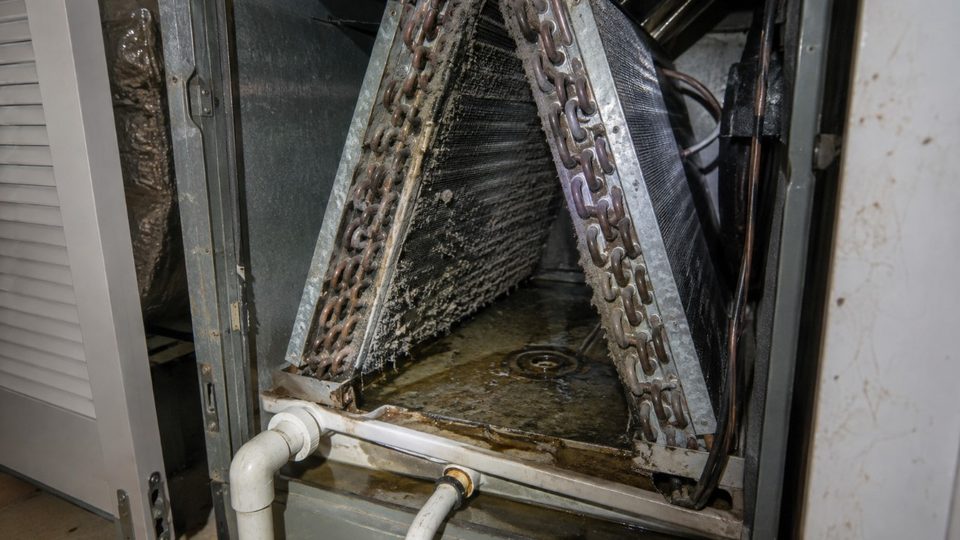
Your HVAC System Is the Only Machine That Can Contaminate the Whole House
A mold problem in a basement corner is a basement problem. The same problem inside an air handler is a whole-building problem, because that machine deliberately moves air from every room, past the affected component, and back to every room, several times an hour. Scale is what makes HVAC contamination significant — a colony the size of a hand on an evaporator coil has more effect on what you breathe than a square metre of growth behind a basement wall.
There is also a specific reason HVAC systems grow mold rather than merely distributing it: air conditioning works by condensing water. Cooling is dehumidification. A residential system in a humid Pennsylvania July removes several gallons of water a day from the air, and every drop of it forms on the evaporator coil and runs into a pan. You have a permanently wet, dark, dust-fed component sitting in the middle of the air stream. It is, by design, the most favourable location for growth anywhere in the building.
Where It Actually Grows
The evaporator coil
The most common location and the most consequential. The coil is wet whenever cooling runs, and its fins trap the fine dust that gets past the filter. That combination — moisture plus organic dust in darkness — produces a biofilm on the coil face. Symptoms are a musty smell that appears specifically when the system starts, and gradually reducing airflow and cooling capacity as the fins block.
The condensate drain pan and line
The pan sits under the coil and collects that water. The drain line is a small-diameter pipe that is expected to remain clear indefinitely, which it does not. Biological slime builds up in the line and eventually blocks it, at which point the pan overflows. In an attic or upper-floor closet installation that overflow lands on the ceiling below. Rusted-through pans, pans pitched the wrong way after a sloppy installation, and missing or blocked secondary pans are all routine findings.
The blower compartment and plenum
The blower wheel accumulates a felt of dust. The supply plenum immediately downstream of the coil sees the highest humidity in the system. Internally lined plenums — fibreglass duct board, or sheet metal with interior liner — are particularly problematic, because a porous lining cannot be cleaned in the way bare sheet metal can.
The ductwork itself
Less often than homeowners assume, and this is worth saying plainly. Bare sheet metal duct in a conditioned space is generally a poor environment for growth — it is non-porous and usually dry. Growth in ducts occurs where specific conditions exist: internally lined duct that has been wetted, flexible duct with damaged liner, duct running through a humid unconditioned crawl space or attic where the exterior condenses, duct that flooded, and duct downstream of an already contaminated coil.
This distinction matters commercially, because “air duct cleaning” is sold aggressively and often unnecessarily. If the coil is the problem and the ducts are bare metal and dry, cleaning the ducts achieves very little while leaving the actual source in place.
Humidifiers
Whole-house humidifiers mounted on the furnace hold standing water by design. Bypass and drum-type units in particular require regular pad replacement and cleaning, and when neglected they become a reliable source. If you have one and cannot remember when it was last serviced, that is where to look first.
Symptoms That Point at the HVAC System Rather Than the Building
| What you notice | What it suggests |
|---|---|
| Musty smell only for the first minutes after the system starts | Growth on the coil or in the plenum — the first push of air carries it |
| Smell is equally strong in every room | Distribution through the system, not a localised room source |
| Symptoms improve when the system is off for a day | Points strongly at the system rather than the building |
| Water stain on the ceiling below an attic or closet air handler | Condensate pan or drain line failure |
| Cooling capacity gradually declining over a season or two | Fouled coil restricting airflow |
| Visible dark growth on supply register vanes | Contamination upstream, in the duct or at the coil |
| Dust discharge visible from registers when the system starts | Loose debris in the duct system |
| Smell is worse in one zone only | Localised duct issue in that branch, or a leak drawing from a contaminated space |
What Proper HVAC Remediation Involves
- Inspect before quotingThe coil is examined directly, which means opening the cabinet, not shining a torch at a register. The pan, drain line, blower, plenum and a representative sample of duct are all assessed. Camera inspection of duct runs where warranted.
- Shut down and isolateSystem off. Registers sealed where necessary so that cleaning one part does not distribute debris through the rest.
- Clean the coil properlyThe coil is accessed and cleaned with an appropriate coil cleaner, working the full depth of the fin pack rather than just the face. A surface wipe of a coil that is fouled three inches deep accomplishes nothing.
- Service the drain systemPan cleaned and treated, drain line cleared and flushed, pan pitch and condition checked, secondary pan and overflow switch verified or installed. A float safety switch that shuts the system down on overflow is inexpensive insurance in an attic installation.
- Clean the blower and plenumBlower wheel removed and cleaned where fouled. Plenum interior HEPA-vacuumed and cleaned. Damaged internal liner is removed rather than cleaned.
- Duct cleaning where it is actually warrantedNADCA-standard source removal: mechanical agitation with brushes or air whips combined with continuous HEPA-filtered negative pressure on the system, so dislodged material is captured rather than redistributed. Flexible duct with damaged interior liner is replaced, not cleaned.
- Seal and correctDuct leaks sealed with mastic, particularly on the return side where leakage in an unconditioned space draws contaminated air into the supply. Duct insulation repaired where condensation is occurring.
- Filtration upgradeA MERV 11 to 13 filter in a properly sized housing — verify the system's static pressure tolerance first, because over-restricting airflow can freeze the coil and create the very condensation problem you are trying to prevent.
- The $99 whole-house special. Legitimate source-removal cleaning of a typical residential system takes several hours and costs several hundred dollars at minimum. The cheap advertised price is a door opener followed by an upsell on the doorstep.
- Photographs of mold that are not from your house. A well-documented tactic. Ask to see the growth in place, on your equipment, before agreeing to anything.
- “Sanitising” fogging into the ducts as the main service. Spraying a biocide into a dirty duct does not clean it. Source removal comes first, always.
- A vacuum on a register and nothing else. Without mechanical agitation and system-wide negative pressure, this moves dust around rather than removing it.
- Ozone. Not appropriate in occupied buildings; the EPA does not recommend it for indoor air cleaning.
Prevention, Which Is Mostly Cheap
- Change filters on schedule. The single highest-value habit. A loaded filter both bypasses dirt onto the coil and restricts airflow enough to promote coil freezing.
- Have the condensate drain cleared annually. Part of a standard cooling season service. Ask specifically for it.
- Keep indoor humidity at 30–50%. A system serving humid air works harder and stays wetter.
- Install a float safety switch. Particularly for attic and upper-floor air handlers. It shuts the system down before the pan overflows through your ceiling.
- Consider UV-C at the coil. There is reasonable evidence that a correctly positioned lamp keeps the coil and pan free of biofilm. Claims about sterilising air passing through the duct are much weaker.
- Seal return-side duct leaks. Return leakage in a crawl space, basement or attic pulls air from that space directly into what you breathe.
Frequently Asked Questions
Often, no — and this is one of the most oversold services in the trade. Bare sheet metal ductwork running through conditioned space is generally dry and non-porous, which makes it a poor environment for growth. Duct cleaning is genuinely warranted when: there is visible growth inside the duct or on register vanes; the ducts were flooded or water-damaged; the system was running during construction or renovation; there is a rodent or insect infestation; flexible duct liner is damaged or deteriorating; or duct runs through a humid crawl space or attic and is condensing. What is far more often the real problem is the coil, the drain pan and the blower — and those need direct servicing, not duct cleaning.
General market ranges for this area: coil cleaning and drain service, roughly $300 to $800. Blower and plenum cleaning, roughly $400 to $1,200. NADCA-standard source-removal duct cleaning for a typical residential system, roughly $600 to $1,500 depending on the number of runs and system size. Full system remediation including coil, blower, plenum and ducts, roughly $1,200 to $3,500. Flexible duct replacement where the liner has failed, roughly $40 to $90 per linear foot. Commercial systems are considerably higher and genuinely require a site visit to price. Planning ranges, not quotes.
Almost certainly the evaporator coil or the condensate pan. The reason the smell appears specifically at start-up is that the first push of air carries the accumulated microbial volatile organic compounds from the wet, stationary coil into the house before steady airflow dilutes them. This is one of the most recognisable diagnostic patterns in residential HVAC. Have the coil examined directly — meaning the cabinet opened, not a torch shone at a vent — along with the drain pan and line. It is frequently a straightforward service item rather than a large remediation project.
It depends on the material. Bare sheet metal duct is non-porous and cleans well; replacement is rarely necessary. Flexible duct with a damaged or deteriorated interior liner cannot be reliably cleaned and should be replaced — the liner is porous and once contaminated it holds material that brushing does not reach. Fibreglass duct board and internally lined metal duct are the difficult middle case: they are porous, they cannot be cleaned to the same standard as bare metal, and once genuinely contaminated replacement is usually the honest answer even though it costs considerably more. Any contractor who tells you a contaminated fibreglass liner can be cleaned back to clean condition is overselling what the method can do.
It depends where it is pointed. A UV-C lamp positioned to shine continuously on the evaporator coil and drain pan is supported by reasonable evidence — it keeps biofilm from establishing on the surfaces that stay wet, which is exactly where the problem starts. That is a legitimate and worthwhile application in a humid climate. In-duct lamps intended to sterilise the air flowing past are much weaker: air moves through the duct in a fraction of a second, and contact time at that velocity is far too short to inactivate most organisms. So: coil-mounted, yes, reasonable. Marketed as an air steriliser, treat the claims sceptically. And it is never a substitute for cleaning a coil that is already fouled.