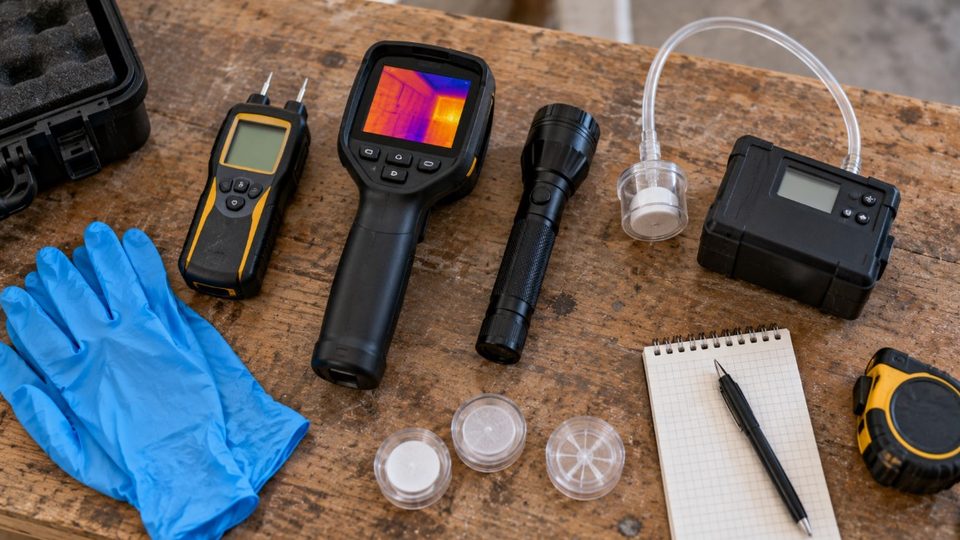
They Answer Different Questions
These two get conflated constantly, including by contractors selling them, and the confusion costs people money in both directions — some pay for testing that tells them nothing they did not know, and others skip an inspection and spend thousands remediating a problem whose cause was never found.
The distinction is simple once stated:
| Mold inspection | Mold testing | |
|---|---|---|
| The question it answers | Where is the water coming from, and how far has this actually spread? | What organisms are present in this sample, and at what concentration? |
| Method | Visual survey, thermal imaging, pin and pinless moisture metering, dew point analysis, borescope | Air cassettes, surface swabs, tape lifts or bulk samples, analysed by a laboratory |
| Output | A diagnosis, a defined extent, and a scope of work | A quantitative laboratory report |
| What it cannot do | Prove air quality or identify a species | Tell you where the water is coming from |
| Typical cost here | $300–$700 | $300–$600 |
| Turnaround | Report usually within 24–48 hours | 2–5 business days for laboratory analysis |
Inspection is for discovery. Testing is for documentation and verification. If you want to know whether you have a problem and what caused it, you inspect. If you need to prove something to an insurer, a landlord, a buyer, a seller or yourself after remediation, you test.
When You Need an Inspection
Almost always, and it should generally come first. An inspection is what produces a cause and an extent — and without those, any remediation is guesswork and any quote is unverifiable.
- You can smell it but cannot see it. Odour without visible growth is the textbook case for instrumented inspection.
- After any water event, once the visible water is gone. The question is never whether the floor is dry — it is whether the material inside the wall is.
- Before buying. See inspection for home buyers.
- Before finishing a basement. Knowing how the foundation behaves before you cover it is the cheapest mold prevention available here.
- Where growth has returned after cleaning — which proves the source was never found.
- Before accepting any remediation quote you cannot verify.
When Testing Actually Earns Its Cost
Testing is worth paying for in a narrower set of circumstances than it is usually sold in.
- Post-remediation clearance. The strongest use case by a distance. It is the only objective proof the work succeeded, and it must be performed by a party independent of the remediation contractor. See post-remediation verification.
- Insurance claims. Adjusters want laboratory data, tied to dated photographs and moisture readings.
- Real estate transactions. Either establishing condition as a buyer, or documenting a resolved problem as a seller.
- Landlord and tenant disputes. Documentation is what converts a complaint into evidence under the implied warranty of habitability.
- Odour with no located source. Cavity air sampling can settle the question before anything is cut open.
- A physician has specifically requested species identification.
When Testing Is Usually a Waste of Money
If you can see the mold, you know where the water came from, and you are going to remediate regardless — pre-testing rarely changes anything. You already know there is mold; a number confirming it does not alter the scope of work. Spend it instead on the inspection that finds the cause and on clearance testing afterwards, which proves something.
A contractor who insists on extensive pre-remediation testing for a straightforward, visible, well-understood problem is adding cost without adding information. That is worth saying out loud, because it happens frequently.
- No outdoor control sample. Mold is a normal component of outdoor air, and outdoor counts in Montgomery County swing by more than an order of magnitude between February and September. An indoor number without a same-day outdoor comparison cannot be interpreted at all.
- A declared “safe” or “unsafe” threshold. No United States federal agency publishes a numerical exposure limit for airborne mold. Any report stating a pass or fail against a number is applying an in-house convention, not a standard.
What Most People Should Actually Do
- Describe it on the phone firstThe seasonal pattern, the location and the age of the building narrow the cause considerably before anyone visits. In a fair number of cases this establishes that you need neither service.
- Get the inspectionWith numeric moisture readings at named locations, a stated moisture source, and a defined extent. That document is what lets you put the work out to competitive quote.
- Add testing only if you need the paperInsurance, dispute, transaction, or an unlocated source. Otherwise skip it at this stage.
- Always test at the endIndependent clearance testing after remediation, by someone with no financial stake in the result. This is the test that is genuinely worth the money on almost any job of consequence.
Frequently Asked Questions
The inspection, in nearly every case. It produces a cause, a defined extent and a scope of work — the three things that determine whether remediation succeeds and whether a quote is reasonable. A test result without an inspection tells you that mold exists, which you probably already suspected, and gives you nothing to act on. The single exception is where you specifically need laboratory documentation for a dispute or a claim and the cause is already established.
For the initial assessment, yes, and it is common and generally fine. For post-remediation clearance testing, no — a contractor testing their own work has an obvious financial interest in a passing result, and every serious protocol calls for that final verification to be independent. Given that Pennsylvania licenses nobody in this trade, that independence is close to the only external check available to you. Settle who performs it, and who pays for a retest, in the contract before work starts.
They overlap less than buyers expect. A general home inspection is a broad visual survey of the entire property in two to three hours; it will note visible growth and visible staining and flag conditions suggesting moisture. What it does not normally include is systematic moisture metering of wall cavities, thermal imaging with confirming meter readings, dew point analysis against surface temperatures, or borescope inspection behind finished surfaces. In this region the dominant mold problem is concealed behind finished basement walls and inside kneewall attics — which is precisely what a visual survey cannot reach.
A thorough instrumented mold inspection of a typical single-family home here takes two to three hours, with a written report usually within 24 to 48 hours. A larger or historic property with multiple additions and a complicated basement can take four hours or more. Sampling itself is quick — a few minutes per air sample — but laboratory turnaround is two to five business days, with next-day rush usually available for an additional fee.
Generally not on health grounds alone. Testing does not establish whether a building is making anyone ill — there is no exposure threshold to compare a result against, and symptoms are a matter for a physician rather than an air sample. Where testing is worth doing with no symptoms present is for documentation: a transaction, a claim, a dispute, or verifying that completed remediation actually worked. If nobody is unwell and you have no paperwork requirement, an inspection is almost certainly the better use of the money.