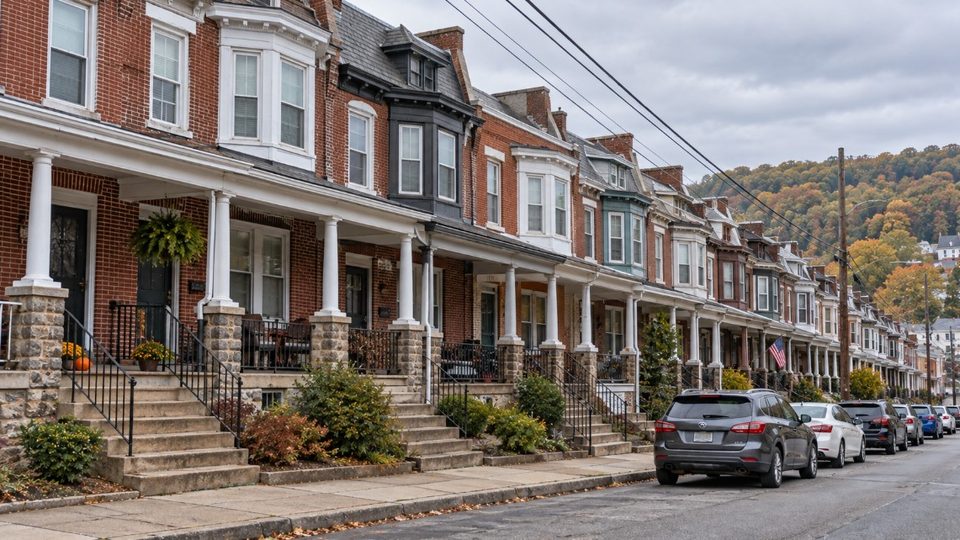
The County Seat, the River, and a Very Old Housing Stock
Norristown is the seat of Montgomery County, sitting on the north bank of the Schuylkill. It is one of the oldest and most densely built communities in our coverage area, with a housing stock dominated by nineteenth and early twentieth century twins, rowhomes and Victorians, plus later suburban development in the outer sections and across the adjoining townships.
Three things drive mold work here: the river, the age of the buildings, and the proportion of rental property — which turns a good number of technical problems into landlord-and-tenant problems.
The Schuylkill and Stony Creek
The Schuylkill gauge at Norristown has flood stage at 13 feet. Its all-time record crest is 25.10 feet, set during Hurricane Agnes in June 1972; Hurricane Floyd brought it to 22 feet in September 1999.
On 1 September 2021 the remnants of Hurricane Ida produced catastrophic flooding across southeastern Pennsylvania. The USGS recorded new peak streamflows of record at numerous gauges across the region during that event. Historic flooding along the river damaged homes and businesses in the Norristown area and in neighbouring Bridgeport, bridges between the boroughs were closed, and flooding closed the Norristown Transportation Center.
Stony Creek runs down through the borough to join the Schuylkill and contributes its own, more localised flash flooding in the low ground along its corridor during heavy rain.
The material point for any property owner: riverine floodwater is Category 3 — black water, having passed over roads, through storm drains and frequently through sanitary sewer systems. All porous material it contacted must be removed. Drywall, insulation, carpet, pad and cabinetry come out. Drying and cleaning in place is not the standard for this category of water, whatever anyone tells you.
The September 2021 event overwhelmed the regional contractor market for months. A great deal of the work done in that period was rushed: standing water removed, surfaces cleaned, replacement drywall installed, but wall cavities never dried to documented targets and no clearance testing carried out. Where Category 3 water reached porous material that was covered over instead of removed, that contamination is still inside the wall. If your Norristown property flooded then and something has not smelled right since, it is worth having properly investigated — and worth doing before you try to sell.
Twins, Rowhomes and Shared Walls
Norristown's dense attached housing brings the party-wall problem: a shared masonry wall transmits moisture, so a failed downspout, an untreated cellar or a leak in a neighbouring property migrates through and appears on your side. Remediating your side alone does not hold when the source is next door.
Because Norristown has a substantial proportion of rental and absentee-owned property, this frequently becomes a documentation exercise rather than a construction one. The route that works: get an inspection report showing the moisture gradient rising toward the party wall, put it in writing to the owner or landlord, and where the neighbouring property is a rental, understand that Pennsylvania’s implied warranty of habitability gives those tenants standing to compel action. For vacant or bank-owned property, Norristown code enforcement is the channel.
Tenants and Landlords
Pennsylvania has no mold-specific statute. What governs residential rental property is the implied warranty of habitability, established in Pennsylvania case law, requiring a landlord to maintain a rental in a condition fit for human habitation. Significant water intrusion and mold growth have been treated as habitability matters.
If you rent: give written notice and keep a copy, photograph everything with dates, and keep a record of every communication. Do not withhold rent without first getting advice on the correct procedure — improperly executed rent withholding is grounds for eviction, and the procedure is specific.
If you are a landlord: respond in writing promptly, document with dates, get an independent inspection before any demolition, and fix the moisture source rather than the visible growth. In Pennsylvania habitability disputes, landlords rarely lose on the mold — they lose on documented delay and undocumented work.
None of this is legal advice. Where tenancy or money is at stake, speak to a Pennsylvania attorney; Montgomery County Legal Aid is a resource for tenants who cannot afford private counsel.
Old Buildings, Old Systems
- Cellars with no damp-proof course — stone and early block, in permanent capillary contact with the ground, worse on the low ground near the river.
- Galvanised supply and cast-iron drain piping — original to much of the stock and long past service life. The leading concealed water source in pre-1950 housing.
- Plaster on wood lath — tolerates brief wetting better than drywall, but the lath behind is cellulose and the cavity is hard to reach.
- Flat and low-slope rowhome roofs — unforgiving of drainage failure; ponding finds every seam.
- Cellar conversions — where a cellar has been finished as living space or a rental unit, frequently with no moisture strategy at all. In a flood-exposed low-lying property this is the highest-risk configuration there is.
- Deferred maintenance generally — gutters, pointing, grading. Much of what we find in Norristown is not exotic; it is thirty years of small things.
Lead and Asbestos
Given the age of the housing, this is a routine consideration rather than an edge case. Any pre-1978 building may contain lead paint, and pre-1980 buildings frequently contain asbestos in pipe lagging, floor tile, mastic and textured finishes. Both carry obligations separate from the mold work and both need identifying before demolition. Testing in advance costs a few hundred dollars; discovering it midway stops a job that is already under containment.
What We Get Called About Most in Norristown
Ranked by how often it comes up, and tied to the buildings that are actually here rather than to mold in general.
- Incomplete Ida remediationStill the most common flood-related call. Where Category 3 water reached porous material that was covered rather than removed, the contamination is inside the wall and producing the odour owners describe as 'never right since'.
- Landlord and tenant disputesWith a substantial rental stock, many calls are documentation problems rather than construction ones. Pennsylvania has no mold statute; what applies is the implied warranty of habitability, and outcomes turn on the written record.
- Party wall moisture in twins and rowhomesA shared masonry wall transmits moisture, and where the neighbouring property is vacant or absentee-owned, borough code enforcement is the practical route.
- Converted cellars used as living spaceFinished below grade with no moisture strategy, in a flood-exposed low-lying property. The highest-risk configuration in the borough.
- Stony Creek corridor flash floodingSeparate from the Schuylkill and more localised — heavy rain produces rapid rises in the low ground along the creek.
Neighborhoods and Sections We Cover in Norristown
Mold Services Available in Norristown
Mold Inspection
Thermal imaging and moisture metering to locate the source before anything is opened up.
DetailsBasement Mold Removal
The dominant mold problem in Norristown — finished walls, stone foundations and sump failures.
DetailsBlack Mold Removal
Full containment for water-damage indicator species, plus finding the sustained water source.
DetailsAttic Mold Removal
Sheathing and rafter growth traced back to ventilation, bath fans or ice damming.
DetailsWater Damage & Flood Mold
Burst pipes, sump failures and flooding — the 24 to 48 hour response window.
DetailsClearance Testing
Independent verification by a hygienist who did not perform the remediation.
DetailsWhat Mold Work Costs in Norristown
General market ranges for the Greater Philadelphia area, listed for the situations that actually come up in Norristown. These are planning figures rather than quotes — nobody can price a job they have not seen, and what moves a number most is the size of the wet area rather than the stained area. The full cost guide explains what drives each one up or down.
| Work | Typical range | Notes |
|---|---|---|
| Mold inspection with thermal imaging and moisture metering | $300–$700 | Most projects should start here |
| Emergency extraction and structural drying | $1,500–$5,000 | Within 24 hours this usually prevents the job above |
| Post-flood remediation, Category 3 water in living space | $8,000–$25,000+ | All contacted porous material must be removed |
| Unfinished basement clean, treat and dehumidify | $1,500–$5,000 | Where there is no finished wall assembly to remove |
| Party wall investigation and documentation | $300–$700 | The inspection report is what opens the conversation next door |
| Sump pump replacement with battery or water-powered backup | $800–$2,500 | The highest-value preventive spend in a low-lying property |
| Lead and asbestos testing before demolition (pre-1978 building) | $400–$1,200 | Far cheaper in advance than discovered mid-job |
| Independent post-remediation clearance testing | $350–$700 | The only stage that produces evidence rather than assurance |
Mold FAQ — Norristown, PA
Pennsylvania has no mold-specific statute, but the implied warranty of habitability — established in Pennsylvania case law — requires a landlord to keep a rental fit for human habitation, and significant water intrusion and mold have been treated as habitability matters. The practical steps: give written notice and keep a copy, photograph everything with dates, keep a log of every communication, and consider getting an independent inspection so you have evidence rather than an opinion. Do not simply stop paying rent — there are procedures such as rent escrow, and getting the procedure wrong exposes you to eviction. Speak to a Pennsylvania attorney before withholding anything; Montgomery County Legal Aid can help if private counsel is not affordable. This is general information, not legal advice.
Most likely because the repair was incomplete, which was very common in the months after 1 September 2021 when contractor capacity across the region was overwhelmed. Riverine floodwater is Category 3 and the standard requires removing all porous material it contacted. What frequently happened instead: water extracted, surfaces cleaned, new drywall hung over framing and insulation that were never dried to target, and no clearance testing. The contamination is then sealed inside the wall, still producing microbial VOCs — which is the smell. Moisture metering and cavity air sampling will confirm it, and it is much better to know now than when a buyer's inspector finds it.
General market ranges for this area: a small contained area, roughly $600 to $1,800. A cellar remediation in an older twin or rowhome, roughly $3,000 to $9,000. Post-flood remediation where Category 3 water reached living space, commonly $8,000 to $25,000 because all contacted porous material must come out. Inspection roughly $300 to $700. Lead and asbestos testing before demolition in a pre-1978 building, roughly $400 to $1,200. For rental property, budget for documentation as well — an independent report is what protects you in a habitability dispute. Planning ranges, not quotes.
No — the exposure is concentrated in the low ground near the Schuylkill and along the Stony Creek corridor. Much of the borough sits well above the river on higher ground and is not in a mapped flood zone. The reliable way to know is to check the specific property against the FEMA flood map rather than judging by eye, since the topography here changes quickly over short distances. If you are buying, ask the seller directly whether the property took water on 1 September 2021, and treat an evasive answer as informative. Properties on higher ground still have the age-related problems — old cellars, old plumbing, deferred maintenance — which is where most of our Norristown work actually is.
Deal with it before listing, and document it. Under Pennsylvania's seller disclosure law you must disclose known material defects, and a past water event with no record of proper remediation is a difficult thing to disclose and a worse thing to be found out over. Get an inspection, get the work done properly with independent clearance testing, and keep the complete file — inspection report, scope of work, drying logs, clearance report. A documented and cleared remediation is a far smaller drag on a sale than an unresolved unknown, and it removes the leverage a buyer's inspector would otherwise have three days before closing.