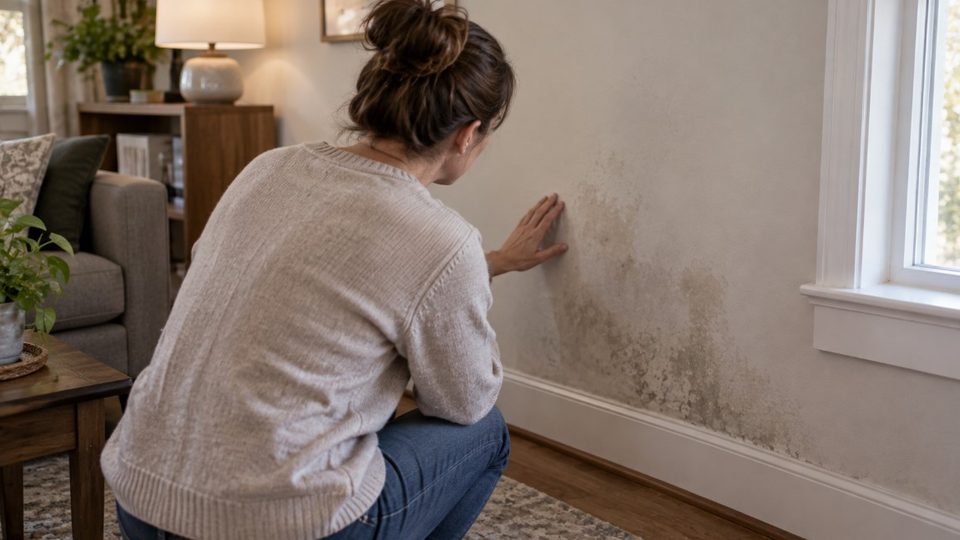
Identifying a problem
Mold is filamentous — fuzzy, speckled or slimy — and usually green, black, grey, brown or white. It grows in patches that spread outward. Dampness alone shows as darkened material, a tide line, or blistering paint. The commonest confusion in this region is efflorescence: a white, crystalline, powdery deposit on masonry that brushes off dry and dissolves in water. That is mineral salt left behind as water evaporates out of the wall — not mold, but proof that water is moving through the masonry. A musty or earthy smell with nothing visible means active growth somewhere: odour is produced by living colonies.
In this region the overwhelmingly likely answer is behind a finished basement wall — on the back of the drywall, on the bottom plate, or inside the fiberglass. That assembly is invisible from the room and can grow for years before anything shows. In an unfinished basement, check the rim joist behind the insulation batts, under the stairs, behind stored cardboard, and the underside of the subfloor. Confirming it takes moisture metering, a thermal scan, and often a small borescope port placed low where a baseboard covers the repair. Do not dismiss a persistent musty smell because nothing is visible.
No — almost certainly efflorescence. It is crystalline, it brushes off as a powder, and it dissolves in water. Mold is filamentous and typically fuzzy. But efflorescence is not good news: it is direct physical evidence that liquid water is passing through that wall and evaporating at the inside face. Treat it as a diagnostic finding rather than a cosmetic one.
Yes, and in southeastern Pennsylvania that is the most common case. A buried foundation wall sits at roughly 52–58°F year round. From June to September, regional dew points run in the mid-60s to low 70s°F. Humid air reaching that cold wall is already below its dew point and condenses liquid water onto it. No leak is involved at all. The same happens on cold water lines, on the rim joist, and in winter on the back of exterior sheathing and the underside of roof decking.
You cannot, by looking — and neither can anyone else. Dozens of common genera present as dark green or black growth. Confirming Stachybotrys chartarum requires a laboratory-analysed sample. The more useful question is whether the answer would change anything: usually it would not, because the removal protocol is the same either way. See black mold removal for the honest version.
Health and safety
Possibly, and this needs a careful answer. What is well established: damp indoor environments and visible mold are associated with respiratory symptoms, worsening asthma, allergic rhinitis and hypersensitivity pneumonitis, with greater effect on people who have allergies or asthma, are immunocompromised, or are infants. Dead spores still trigger allergic response, which is why killing mold without removing it is insufficient. What is not established is the claim that mycotoxin exposure in ordinary residential buildings causes a distinct syndrome of neurological or systemic illness. If you have health concerns, that is a conversation for your physician — not for a remediation contractor.
Usually not, for contained work in a defined area. Consider relocating if the work is extensive, if the HVAC system must be shut down during a heat wave or cold snap, if containment blocks the only bathroom, or if a household member is immunocompromised, pregnant, an infant, or has significant respiratory disease. Raise it before work starts — if additional living expenses form part of an insurance claim, it needs documenting from the outset.
For a genuinely small area — under roughly ten square feet, on a hard non-porous surface, where the water source is identified and fixed, and nobody in the household is asthmatic or immunocompromised — yes. Wear an N95 or better, gloves and sealed eye protection. Damp-wipe rather than dry-brushing or sanding, which aerosolises spores. Bag waste inside the room. HEPA-vacuum afterwards. Stop if you open something up and find more than you expected — that is exactly how a contained problem becomes a whole-house one.
On hard non-porous surfaces like tile or glazed porcelain, it works adequately. On porous material — drywall, wood, plaster — it does not, and it can make things worse. Household bleach is mostly water; the chlorine stays largely at the surface while the water carries into the material. You may remove the visible discolouration while leaving the organism embedded and adding moisture to the substrate. For porous material the standard-of-care answer is removal, not treatment.
Inspection and testing
If the area is genuinely small, on a non-porous surface, and you have identified and fixed the water source — often no. An inspection earns its cost when the area is larger, when you cannot identify where the water came from, when growth is on or behind porous material, when it has recurred after cleaning, or when the visible mold looks like the edge of something inside an assembly.
It depends on what you need it for. Testing is for documentation and verification, not discovery. If you can see the mold and are going to remediate regardless, pre-testing often adds cost without changing anything. It is genuinely worth paying for: post-remediation clearance, insurance claims, real estate transactions, landlord-tenant disputes, odour with no located source, and where a physician has asked for species identification.
Because mold is a normal component of outdoor air everywhere, and outdoor counts in Montgomery County swing by more than an order of magnitude across the seasons. An indoor reading of 900 spores per cubic metre might be unremarkable in September and a red flag in February. Indoor results are only interpretable relative to an outdoor control taken the same day. A report without one is close to useless — and there is no federal numerical limit for mold, so any “pass/fail” threshold without a control is an in-house convention, not a standard.
No. They will grow colonies from any indoor air in any building on earth, because normal air contains viable spores. They have no calibrated sample volume, no outdoor control, and no way to distinguish normal background from amplification. The output is a frightening plate that means nothing. If you need a document someone else will act on, the only useful test uses a calibrated pump and an accredited laboratory.
The work itself
Seven stages: identify and correct the moisture source; assess and scope the extent in writing; contain the area with HEPA-filtered negative air; remove contaminated porous material and clean what remains; dry to documented numeric targets with daily logging; verify with independent clearance testing; then rebuild. See mold removal and remediation for the detail.
Because you cannot clean mold out of porous material. Drywall paper facing, fiberglass batt insulation, carpet pad and ceiling tile absorb contamination into their structure, and no surface treatment reaches it. Framing lumber, concrete and masonry are different — they are cleaned mechanically and generally saved. Cut lines also extend beyond the visible damage, usually twelve to twenty-four inches past the last elevated moisture reading, because the concealed face is almost always worse than the visible one.
Because it is the only stage that produces evidence rather than assurance. A contractor testing their own work has a direct financial interest in a passing result. In Pennsylvania, where nothing about this industry is licensed or inspected, that independence is close to the only external check available to you. It costs a few hundred dollars on a job costing thousands. Settle in the contract, before work starts, who performs it, what the pass criteria are, and who pays for a retest.
Only if the moisture source was not corrected — and that is essentially the only reason recurrence happens. Mold does not grow on dry surfaces. If it returns to the same place, the cause was never addressed and you paid for cleaning rather than remediation.
Dry fogging is a useful supplementary tool for treating cavities and contents that cannot be reached mechanically. It is not a substitute for removing wet contaminated material, and any company proposing it instead of demolition where there is saturated drywall or insulation is selling an odour treatment. Ozone is a different matter entirely: it is a respiratory irritant, the EPA does not recommend it for indoor air cleaning, and the concentrations needed to affect mold exceed those considered safe for people.
Pennsylvania specifics
No. There is no state licensing or registration programme for mold inspectors or remediation contractors in Pennsylvania. No board, no exam, no inspection regime. Anyone may legally offer this work. Verification is entirely your responsibility: ask for general liability and pollution liability insurance, IICRC S520 certification, and — for any construction or repair work, which is regulated — a PA Home Improvement Contractor registration number, checkable free through the Office of Attorney General.
Generally yes when it results from a sudden and accidental covered event — a burst pipe, a failed water heater, an appliance line, storm damage. Generally no for long-term seepage, condensation, groundwater or deferred maintenance. Surface flooding is never covered and requires separate NFIP coverage. Two gaps matter particularly here: sump pump failure and sewer backup are typically excluded and both are available as inexpensive endorsements. Many policies also carry a mold sublimit, commonly $5,000–$10,000.
The Real Estate Seller Disclosure Law requires sellers of residential property to disclose known material defects, and the standard form covers water infiltration in basements and crawl spaces, roof leaks, plumbing problems and known mold. The key limitation is that the duty is to disclose what the seller knows — it is not a warranty of condition and it creates no duty to investigate. Certain transactions are exempt. Read the statement, note what is answered “unknown”, and inspect anyway. This is general information, not legal advice.
Pennsylvania has no mold-specific statute. What applies is the implied warranty of habitability, established in Pennsylvania case law, requiring a landlord to keep a rental fit for human habitation; significant water intrusion and mold have been treated as habitability issues. Practical steps: written notice with a copy kept, dated photographs, a log of all communication, and ideally an independent inspection. Do not simply withhold rent — there are procedures such as rent escrow and getting the procedure wrong exposes you to eviction. Speak to a Pennsylvania attorney; Montgomery County Legal Aid is a resource if private counsel is not affordable. This is general information, not legal advice.
It is a sensible moment to, yes. Montgomery and Chester Counties sit in an area of elevated radon potential, and roughly 40 percent of Pennsylvania homes tested exceed the EPA action level of 4 pCi/L. Radon and moisture share entry pathways — the slab-to-wall joint, cracks, the sump pit — so sealing work for one often benefits the other. They are separate problems requiring separate testing. Note that unlike mold, radon mitigation in Pennsylvania is regulated: the DEP certifies testers and mitigators, so there is an actual credential to check.
Prevention
30 to 50 percent relative humidity year round — nearer 30–40% in deep winter and 45–50% in summer. In winter, pushing above 40% in an older Pennsylvania house drives moisture into cold wall and roof assemblies where it condenses out of sight. In summer, anything sustained above 55% in a basement supports growth on cool surfaces. Measure it — a hygrometer costs less than a takeaway and will tell you more about your house than most paid opinions.
Not from roughly June through September, and this is the single most common mistake made in this region. Opening basement windows on a humid summer day brings 70°F dew-point air onto 55°F masonry, which deposits more water on the wall than the ventilation removes. Close the basement to outdoor air through the humid months and run a correctly sized dehumidifier plumbed to a drain at 45–50%.
Three, and they resolve a surprising share of basement moisture: clear the gutters; extend every downspout to discharge at least six feet from the foundation; and correct grading that has settled so it now falls toward the house. After that, physically trace where every bath fan and dryer duct actually terminates — a fan discharging into the attic is both a common cause and a cheap fix. Do these before anyone quotes you for waterproofing.
Rigid foam board directly against the masonry with taped seams — this is the critical layer, because it raises the interior surface temperature above the dew point and is itself unaffected by moisture. Frame in front of the foam, not against the wall. Mineral wool rather than fiberglass if extra insulation is wanted. Paperless or fibreglass-mat-faced gypsum board. No carpet pad on the slab — a floating floor over a dimpled membrane, or sealed concrete. And permanent dehumidification plumbed to a drain. Roughly fifteen to twenty percent more than the conventional assembly, and it is the whole difference.