Removal Versus Remediation — The Distinction Is Not Marketing
“Mold removal” implies an achievable end state in which no mold remains. That state does not exist in any occupied building. Mold spores are present in all indoor air everywhere, always; they arrive on clothing, through doorways and through every ventilation system. The goal of professional work is not sterilisation, which is impossible, but returning the building to a normal fungal ecology and eliminating the conditions that allowed amplification. That is what remediation means, and it is why the industry standard uses the word.
This is not a semantic quibble. It determines how you should evaluate a quote. A contractor promising to “kill all the mold” with a chemical treatment is promising something that is neither achievable nor the actual objective. The measurable objectives are: the moisture source is corrected, contaminated porous material is physically removed, remaining surfaces are cleaned, the structure is dried to a documented target, and an independent test confirms the space is back to normal.
The IICRC S520 Standard, and Why It Matters More in Pennsylvania
The reference document for this work in the United States is ANSI/IICRC S520, the Standard for Professional Mold Remediation. It is a consensus standard developed by the Institute of Inspection, Cleaning and Restoration Certification. It defines the principles: identify and correct the moisture source, contain the work area, remove contamination rather than merely treat it, protect workers and occupants, and verify the result.
S520 is a standard of care, not a law. Nobody is legally compelled to follow it. And because Pennsylvania has no state licensing or registration scheme for mold remediation contractors at all, voluntary adherence to S520 is effectively the only meaningful line between a professional operation and a man with a shop vac. This is the central practical fact for any property owner in Montgomery or Chester County hiring for this work: verification is entirely on you. Ask directly for IICRC certification numbers, and ask whether the scope of work follows S520.
- Porous material that has been contaminated is removed, not cleaned. You cannot clean mold out of the paper facing of drywall, out of fiberglass batt insulation, or out of carpet pad. It comes out.
- Biocides are not a substitute for removal. Killing an organism does not remove it, and dead spores and fungal fragments remain allergenic. Chemical treatment has a role — on cleaned non-porous surfaces — but it is the last step, never the whole job.
- Bleach is the wrong tool on porous material. Household bleach is mostly water. On wood or drywall the chlorine stays on the surface while the water carries into the material, which can leave the substrate wetter than before. On hard non-porous surfaces it has legitimate uses. On framing lumber it does not.
The Process, Stage by Stage
1. Correct the moisture source first
This is the stage that determines whether the work lasts. In this region the source is most often one of a predictable set: a failed or undersized sump system, negative grading pushing surface water at the foundation, a downspout discharging beside the wall, summer condensation on an uninsulated foundation or rim joist, a bath fan terminating in the attic, ice damming at the eaves, a slow supply or drain leak inside a wall, or a condensate line backing up at the air handler. Remediating without fixing this buys you one season. See moisture source identification.
2. Assess and classify the extent
The affected area is mapped and the work is scoped. Broadly, the industry thinks in three tiers: small isolated areas under roughly ten square feet, mid-size areas up to around a hundred square feet, and extensive contamination beyond that. The tier drives containment requirements, worker protection and whether occupants should remain in the building. You should receive this in writing before anyone starts.
3. Containment and negative air
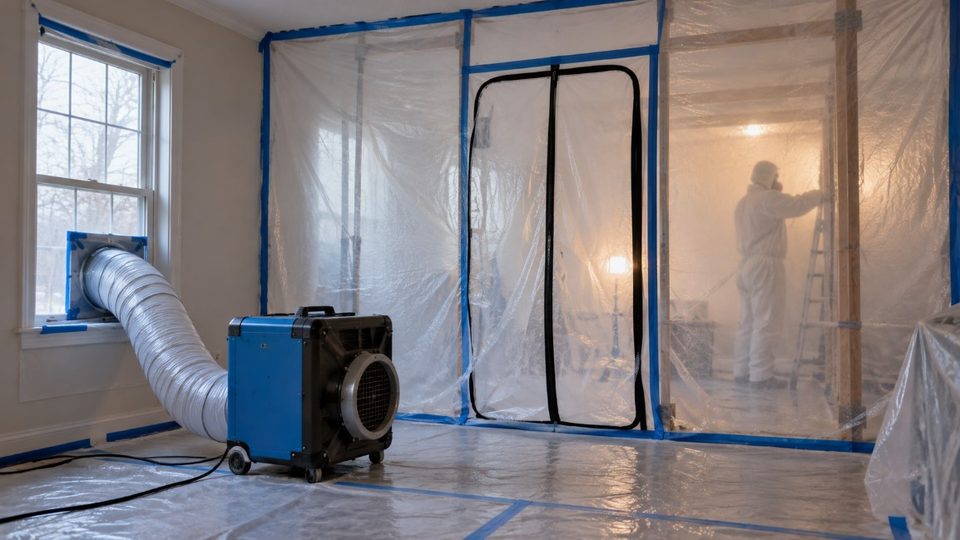
Polyethylene sheeting seals the work area. For larger jobs a decontamination chamber — a small airlock — is built at the entry. HVAC supply and return registers inside the containment are sealed so the system cannot draw contaminated air and distribute it through the house; on significant jobs the system is shut down entirely.
Negative air pressure is then established using a HEPA-filtered air scrubber exhausting outdoors. This is the part homeowners most often do not understand and contractors most often skip to save time. When the work area is held at slightly lower pressure than the rest of the house, air flows into the containment through any gap rather than out of it. Without it, demolition inside a plastic tent still pushes spore-laden air into the rest of the building every time someone opens the flap. Ask specifically whether negative air will be used and where the machine exhausts.
4. Removal and cleaning
Contaminated porous material is cut out and bagged inside the containment. Standard practice is to cut back a meaningful margin beyond the visible or moisture-mapped edge — commonly twelve to twenty-four inches — because growth on the concealed face typically extends further than the visible face. Drywall, insulation, carpet and pad, ceiling tile and affected wood trim generally come out. Structural framing is usually salvageable: it is HEPA-vacuumed, then mechanically cleaned, sometimes by abrasive methods such as soda or dry-ice blasting where staining is heavy.
Remaining surfaces are HEPA-vacuumed and damp-wiped. Only then, on cleaned surfaces, is an EPA-registered antimicrobial applied, with any encapsulant coming after that. The order is not arbitrary — treatment applied over uncleaned growth seals contamination in place rather than removing it.
5. Structural drying
Dehumidifiers and air movers run until the structure reaches documented moisture content targets, with readings logged daily so there is a record. This is where a great many jobs quietly fail: the contractor pulls equipment on a schedule rather than on a measurement, the framing is still at 22% moisture content behind the new drywall, and the problem returns within a year. Drying is complete when the meter says so. Ask for the drying log.
6. Independent clearance verification
A third party who did not perform the remediation confirms the area passes visual inspection and agreed laboratory criteria. This is the only stage that produces objective proof, and it is the one most commonly omitted. Details on post-remediation verification.
7. Reconstruction
Rebuilding what came out. This should be scoped and priced separately from remediation so you can compare bids honestly, and it is a genuine opportunity: if a finished basement wall failed because fiberglass was installed against cold masonry, rebuilding it the same way guarantees a repeat. See mold damage repair.
What Gets Removed, What Gets Saved
| Material | Typical outcome | Why |
|---|---|---|
| Drywall, contaminated | Removed | Paper facing is cellulose — ideal substrate, cannot be cleaned |
| Fiberglass batt insulation | Removed | Traps spores in the matrix; cannot be cleaned; loses R-value once wet |
| Carpet and carpet pad | Pad always removed; carpet usually | Pad is an open-cell sponge that holds contamination indefinitely |
| Framing lumber | Usually saved | Non-porous enough to clean mechanically; structural replacement is a last resort |
| Plywood / OSB subfloor | Case by case | Surface growth can be cleaned; delamination or rot means replacement |
| Concrete and masonry | Saved | Non-porous to fungal penetration; cleaned and HEPA-vacuumed |
| Solid wood trim and doors | Often saved | Can be cleaned and refinished; particleboard equivalents cannot |
| Ceiling tile | Removed | Highly porous mineral fibre |
| Upholstered furniture | Case by case | Can sometimes be professionally cleaned; heavily contaminated items rarely worth it |
| HVAC ductwork, flex | Usually replaced | Interior liner cannot be reliably cleaned. See HVAC mold |
How Long It Takes, and Whether You Have to Leave
A small isolated area — a bathroom wall, a section of a basement — commonly runs one to two days including drying. A mid-size job affecting a room or two typically runs three to five days. Whole-basement remediation after a flood or a long-running failure often runs one to two weeks, and more where reconstruction follows. Drying time is the variable that most often extends a schedule, and it should.
Most households stay in the home for contained work in a defined area. Leaving is worth considering when the work is extensive, when the HVAC system must be shut down in a hot or cold stretch, when the containment blocks the only bathroom, or when someone in the household is immunocompromised, pregnant, an infant, or has significant asthma. This should be an explicit conversation before work begins, not something you discover on day two.
Frequently Asked Questions
General market ranges for Greater Philadelphia: a small contained area such as a bathroom wall or a closet, roughly $600 to $1,800. A single room, roughly $1,500 to $4,500. A finished basement with wall removal and reconstruction excluded, roughly $4,000 to $12,000. Whole-basement remediation after flooding, commonly $8,000 to $25,000 or more. Crawl space work with encapsulation, roughly $4,000 to $15,000. Attic remediation, roughly $2,000 to $7,000. These are planning ranges, not quotes — the full cost guide explains what moves a number up or down.
For genuinely small areas — under roughly ten square feet, on non-porous surfaces, where you have already fixed the water source and nobody in the household has asthma or is immunocompromised — yes, and a competent homeowner can do a good job of it. Wear an N95 or better, gloves and eye protection, contain the area with plastic, do not dry-brush or sand, bag material inside the room, and HEPA-vacuum afterwards. Where DIY goes badly wrong is scope creep: opening a wall, finding the growth extends four feet further, and continuing without containment. That turns a localised problem into a whole-house one. If you open something up and find more than you expected, stop and call.
Only if the moisture source was not corrected — and that is by far the most common reason for recurrence. Mold does not return to a dry surface. If growth reappears in the same place, the cause was never actually addressed; you paid for cleaning rather than remediation. This is why a legitimate written scope names the moisture source explicitly, and why a contractor who cannot tell you where the water came from should not be doing the work.
Usually not for contained work in a defined area. Consider relocating if the work is extensive, if the HVAC system has to be shut down during a heat wave or a cold snap, if containment cuts off the only bathroom, or if a household member is immunocompromised, pregnant, an infant, or has significant respiratory disease. Raise it before work starts — a good contractor will give you a straight answer, and if additional living expenses are part of an insurance claim it needs to be documented from the outset.
No, and this is worth being blunt about. Neither removes contaminated material, and removal is the core of the standard. Fogging has legitimate supporting uses on cleaned, non-porous surfaces — see dry fog remediation for where it genuinely helps. Ozone generators are a different matter: ozone is a respiratory irritant, the EPA does not recommend their use in occupied spaces, and the concentrations required to affect mold are well above those considered safe for people. Any company proposing ozone or fogging instead of removing wet contaminated drywall is selling you an odour treatment and calling it remediation.