What a Mold Inspection Actually Is
A mold inspection is a building diagnosis, not a mold hunt. Finding visible growth is the easy part — you have usually already done that yourself. The job of a competent inspector is to answer three harder questions: where is the water coming from, how far has the contamination actually travelled, and what has to be opened up to know for certain? An inspection that produces a list of places mold was seen, without naming the moisture source that put it there, has not done its job.
This distinction matters more in southeastern Pennsylvania than in most of the country, because the majority of mold in Upper Merion, Tredyffrin and the surrounding townships is not caused by a dramatic leak. It is caused by seasonal condensation on cold surfaces and by slow capillary movement through masonry — processes that leave no stain, no drip and no obvious point of origin. You cannot find those by looking. You find them with instruments.
At the end of a proper inspection you should be able to answer: “Water was getting in from ____, it was wetting ____, and the affected area extends approximately ____.” If the report cannot fill in those blanks, you have paid for a walkthrough, not a diagnosis.
The Instruments, and What Each One Is For
Thermal imaging (infrared camera)
An infrared camera does not see moisture. It sees temperature. Wet material evaporates, evaporation cools the surface, and that temperature difference shows up as a distinct cold signature against the surrounding wall. This is how an inspector finds water inside a wall cavity without cutting it open — a cold plume spreading downward and outward from a supply line, a cold band along the top plate where an ice dam pushed water back under the shingles, a cold rectangle on a ceiling under a bathroom.
Thermal imaging has real limits that an honest inspector will tell you about. It needs a temperature differential to work, so scanning an exterior wall on a mild 68°F October day produces very little. It cannot see through foil-faced insulation or behind tile. And a cold spot is a candidate, never a conclusion — missing insulation, a stud, and a duct run all produce cold signatures with no water involved at all. Every thermal finding has to be confirmed with a moisture meter. An inspector who shows you thermal images and nothing else is selling pictures.
Moisture meters — pinless and pin-type
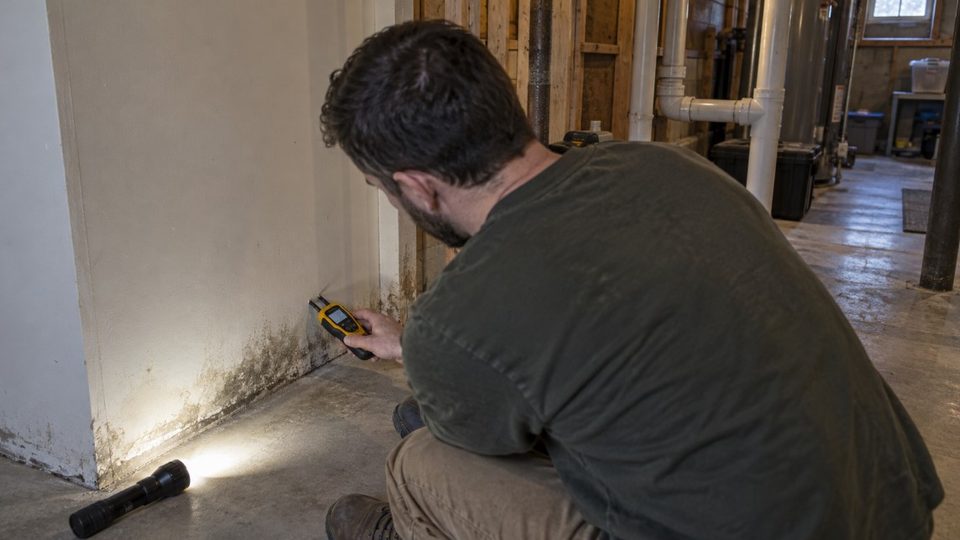
A pinless meter uses capacitance to read moisture content through roughly the first three quarters of an inch of material without damaging it. It is the survey tool: the inspector sweeps it across a wall in a grid, finds elevated readings, and maps the wet zone. A pin-type meter drives two probes into the material and measures electrical resistance between them, giving a true moisture content reading at a known depth. Pin meters leave two small holes, which is why they are used for confirmation rather than survey.
The thresholds that matter in wood-framed construction: wood framing and subfloor should read below roughly 16% moisture content; sustained readings above 20% put the material firmly into the range that supports fungal growth. Gypsum board should read close to 0.5% by weight and anything above roughly 1% indicates it has taken on water. A competent report gives you numbers at named locations, not adjectives.
Hygrometer and dew point calculation
This is the instrument most often skipped, and in this climate it is arguably the most diagnostic of all. Measuring indoor temperature and relative humidity lets the inspector calculate the dew point of the air in the space, then compare it against the measured surface temperature of the foundation wall, the rim joist, or the cold water line. If the surface is colder than the dew point of the surrounding air, that surface is condensing water right now, and it will keep doing so every day the conditions hold — no leak required. This single calculation explains the majority of basement mold in Montgomery County, and it takes about ninety seconds to perform.
Borescope inspection
A borescope is a small camera on a flexible shaft, inserted through a hole roughly the diameter of a pencil. It allows an inspector to see inside a closed wall cavity, inside a kneewall triangle, or behind a finished basement wall without demolition. On a finished basement where thermal imaging and moisture readings both suggest a problem behind the drywall, a borescope is what converts suspicion into evidence. Good practice is to place the inspection hole low on the wall behind a future baseboard line, or inside a closet, so the repair is invisible.
Where a King of Prussia Inspection Actually Goes
A generic checklist inspection walks the finished rooms and looks at bathrooms. That misses most of the mold in this region. Here is the sequence that matches how houses here actually fail.
- The basement perimeter, at floor levelThe bottom eight inches of the foundation wall, the cold joint where wall meets slab, and behind any stored material along the perimeter. Efflorescence — white crystalline deposit on masonry — is the signature of water moving through the wall and evaporating on the inside face. It is not mold, but it proves the mechanism that feeds mold.
- The rim joist / band joistThe horizontal band of framing where the floor structure sits on top of the foundation. It is uninsulated in most pre-1980 homes and stuffed with a bare fiberglass batt in most homes after that. It is the coldest wood surface in the building in winter and a prime summer condensation surface. It is also almost never inspected.
- Behind finished basement wallsWhere a stud wall has been built against the foundation. Moisture metering along the bottom plate, thermal scan of the full wall, and where indicated a borescope. This assembly is the single most common hidden mold location in the local housing stock.
- Under all plumbing fixturesSink base cabinets, behind toilets at the closet flange, the dishwasher bay, the washing machine box, and the water heater pan. Slow drips here run for months.
- Bathroom wet walls and the fan terminationAround the tub or shower surround, at the base of the wall behind the toilet, and critically — where does the bath fan actually discharge? A fan that terminates in the attic instead of through the roof or gable is depositing shower moisture directly onto cold sheathing every day.
- Attic sheathing, rafters and the eavesNorth-facing roof planes first, as they stay coldest. Blackened sheathing near the ridge points to ventilation imbalance; staining concentrated at the eaves points to ice damming; a localised dark cone points to a bath or dryer duct discharging below.
- The air handler, coil and plenumThe evaporator coil, the condensate drain pan and its trap, the return plenum and the first few feet of supply duct. Growth here is significant out of proportion to its size because the system distributes it everywhere.
- Exterior water managementGrading within ten feet of the foundation, downspout discharge points, gutter condition, window well drainage, and the location of the sump discharge. Most chronic basement moisture in this region is ultimately a roof drainage problem.
Inspection Versus Testing — They Answer Different Questions
These are constantly conflated, including by contractors. They are not the same service and one does not replace the other.
| Mold Inspection | Mold Testing | |
|---|---|---|
| Question answered | Where is the water and how far has this spread? | What is airborne or on this surface, and at what concentration? |
| Method | Visual, thermal, moisture metering, borescope | Air cassettes, swabs, tape lifts, sent to a laboratory |
| Result | A diagnosis and a scope | A quantitative laboratory report |
| Needed when | Almost always — this is the foundation of everything | When you need documentation, species identification, or a clearance baseline |
| On its own it | Cannot prove air quality or identify species | Cannot tell you where the water is coming from |
The practical answer for most homeowners: start with the inspection. If you can see the mold, know where the water came from, and the area is small, testing frequently adds cost without changing the plan. Testing becomes genuinely necessary when there is a dispute, an insurance claim, a real estate transaction, an occupant with health symptoms, or a need to establish a pre-remediation baseline that clearance testing can later be measured against. Mold testing is covered in detail here.
When to Get an Inspection
- You can smell it but cannot see it. A persistent musty or earthy odour is microbial volatile organic compounds, and it means growth is active somewhere. Odour without visible growth is the textbook indication for instrumented inspection.
- After any water event, once the visible water is gone. A sump failure, a burst supply line, a backed-up drain, an ice dam, a roof leak. The question is never whether the floor is dry — it is whether the material inside the wall is.
- Before buying. Pennsylvania’s standard home inspection does not include moisture metering of wall cavities or thermal imaging as a matter of course. See mold inspection for home buyers.
- Before finishing a basement. Establishing the moisture behaviour of the foundation before you frame a wall against it is the cheapest mold prevention available in this region.
- Unexplained respiratory or allergic symptoms that improve away from the house. This pattern is worth investigating, though it is important to be clear that no inspection can diagnose a medical condition — that is a conversation for a physician.
- Recurrence. If mold has come back in the same place after being cleaned, the moisture source was never found. That is an inspection problem, not a cleaning problem.
- Photographs of every finding, with location references
- Numeric moisture readings at named locations, not general impressions
- Thermal images with the confirming moisture reading beside each anomaly
- A written statement of the probable moisture source
- An estimate of affected area, and what is still unknown without opening something up
- Clear recommendations separated into “must do” and “should consider”
Honest Limits
No inspection sees everything. Inspectors do not open walls, lift nailed-down flooring, or move a homeowner’s stored belongings, and no instrument sees reliably through tile, foil-faced insulation or masonry. Where conditions strongly indicate a problem behind a closed assembly, a competent inspector will say so plainly and recommend an inspection opening rather than guess. Be wary of any report that presents itself as exhaustive, and be equally wary of one that recommends full demolition on the basis of a thermal image alone.
Frequently Asked Questions
For a typical single-family home in Upper Merion or the Main Line, plan on two to three hours for a thorough instrumented inspection. A small condo or a single-room investigation may take an hour. A large historic property with multiple additions, several roof planes and a complicated basement can take four or more. Be cautious of anything advertised as a thirty-minute inspection — the rim joist survey alone takes longer than that in most homes.
No — and please do not scrub, paint over, or spray anything. Disturbing growth aerosolises spores and can spread a contained problem. It also destroys the evidence needed to judge how long the growth has been active and how far it extends. What genuinely helps: clear physical access to the basement perimeter, the electrical panel area, the attic hatch and any crawl space entry; and make a note of dates of past water events, even approximate ones.
Not visually. No inspector can identify a species by looking at it, and any who claims to should be treated with suspicion — dozens of common genera present as dark green or black growth. Species identification requires laboratory analysis of a sample. That said, from a remediation standpoint it usually does not change the plan. The protocol for removing water-damaged porous material safely is the same regardless of which genus is growing on it. Species identification matters for documentation, for insurance disputes, and occasionally for a physician — not for deciding how to do the work.
If the affected area is genuinely small — roughly under ten square feet, on a non-porous surface, with a moisture source you have already identified and fixed, such as a shower you have since resealed — then often no. Clean it properly and monitor it. An inspection earns its cost when any of the following are true: the affected area is larger than that; you cannot identify where the water came from; the growth is on or behind porous material; it has come back after cleaning; or the mold is on a surface that suggests it is the visible edge of something inside the assembly, such as a bubbling baseboard or a stained ceiling.
Often, yes — and that is what the call is for. The seasonal pattern, the location and the age of the building narrow the likely cause considerably before anyone visits. If your basement is damp every July and dry every January, for instance, that is condensation rather than a leak, and it points at a dehumidifier rather than an inspection. Call (610) 702-8235, describe what you are seeing, and you will get a straight answer — including when the answer is that you do not need one. The inspection itself is carried out by an independent inspector — and before booking one, ask them for the documents listed on our About page, because Pennsylvania licenses none of this.