What “Black Mold” Actually Means
“Black mold” is not a species. It is a colour, and dozens of common fungal genera present as dark green or black growth. In popular usage the term almost always refers to Stachybotrys chartarum, which is a real organism with real significance — but the majority of dark growth people find in their homes is something else, most often Cladosporium, Aspergillus niger or Alternaria.
We want to be straightforward about this rather than trade on the alarm, because the alarm is what a certain kind of contractor sells. Two things are simultaneously true:
- You cannot identify the species by looking at it. Nobody can. It requires laboratory analysis of a sample. Any contractor who declares “that's toxic black mold” on sight is either guessing or working you.
- It usually does not change the plan. The protocol for safely removing water-damaged porous material is the same regardless of which genus is growing on it. Species identification matters for documentation, insurance and occasionally a physician — not for deciding how the work is done.
Why Stachybotrys Is Genuinely Significant
Not primarily because of what it is, but because of what its presence tells you about your building.
Stachybotrys is a slow-growing organism with demanding requirements. It needs cellulose material — drywall paper, cardboard, wood, wallpaper — and it needs that material to be genuinely, persistently wet, typically for a week or more, not merely humid. It cannot establish on a surface that is only damp from condensation. It loses in competition with faster organisms unless conditions strongly favour it.
So finding it is a diagnostic event. It means there has been sustained saturation: a leak running for weeks, a flood that was never dried properly, a chronic plumbing failure inside a wall. Whatever that source is, it is probably still there, and whatever else is wet is probably larger than what you can see. That is the real significance, and it is why its presence warrants a proper investigation rather than a spot clean.
A second practical point: Stachybotrys spores are heavy, sticky and produced in a wet slime layer. They do not readily become airborne while the colony is wet and undisturbed, which is why air samples in a room with active growth sometimes come back low. But disturb it — scrub it, sand it, blow a fan at it, cut into the wall — and it aerosolises heavily. This is the single strongest practical reason not to touch it before it is contained.
Health: What Is Established and What Is Not
This is an area where a great deal of marketing has outrun the evidence, and we would rather give you the honest version.
Well established: Damp indoor environments and visible mold growth are associated with respiratory symptoms, worsening of asthma, allergic rhinitis and hypersensitivity pneumonitis. Institute of Medicine and World Health Organization reviews support this. People with allergies, asthma, or compromised immune systems, and infants, are more affected. Dead spores still cause allergic response, which is why killing mold without removing it is insufficient.
Not established: The claim that Stachybotrys mycotoxin exposure in ordinary residential buildings causes a distinct syndrome of neurological or systemic illness. The organism does produce trichothecene mycotoxins, and those are genuinely toxic in sufficient dose — the open question is whether inhalation exposure in a typical damp house reaches doses capable of causing systemic effects. The CDC's position has been that a causal link between indoor Stachybotrys and serious systemic illness is not established.
The gap between what is established and what is claimed is where inflated quotes live. A contractor who uses the words “toxic”, “deadly” or “poisoning” before a laboratory has identified anything is managing your fear, not your building. The correct response to visible dark growth is neither panic nor dismissal: it is do not disturb it, find out how much water has been where, and get it removed properly. If you have health concerns, that is a conversation for your physician, not for a remediation salesperson.
What to Do Right Now if You Have Found It
- Do not touch itNo scrubbing, no wiping, no sanding, no scraping, no bleach spray. Every one of those disturbs the colony and aerosolises what was previously stuck to a wet surface.
- Do not point a fan at itThe instinct to dry it out with a fan is understandable and it is the worst single thing you can do. It converts a localised contamination into a distributed one.
- Close the room offShut the door. If it is an open area, plastic sheeting and tape are worth the twenty minutes.
- Turn off the HVAC if the growth is near a returnA return register drawing air from a contaminated space distributes it through every room the system serves. If in doubt, switch the system off until it has been assessed.
- Stop the water if you can find itIf there is an active leak and you can shut a valve, do it. If the water source is not obvious, leave it — finding it is part of the job.
- Photograph everything, with datesBefore anyone touches anything. If insurance or a landlord dispute follows, these photographs are the most valuable thing you will own.
- Keep vulnerable people outAnyone with asthma, allergies or a compromised immune system, plus infants and pregnant household members, should stay out of that area until it is contained.
- Call for an assessmentDescribe what you see, where, how large, and what water event you know of. Free phone consultation on (610) 702-8235.
How Removal Is Carried Out
Because Stachybotrys indicates sustained saturation, these projects are almost always larger than the visible patch suggests. The standard sequence, following IICRC S520, with the emphasis shifted:
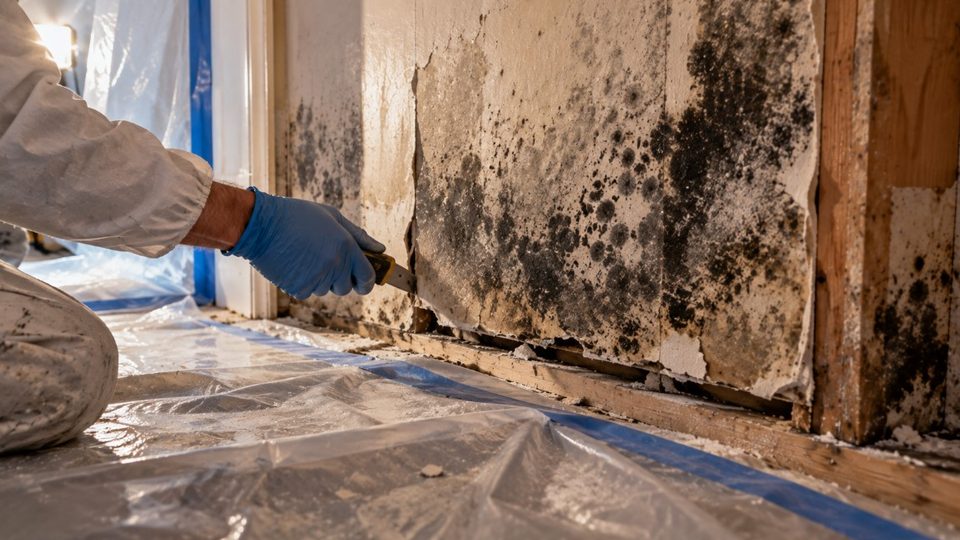
Full containment, with no shortcuts. Sealed polyethylene barriers, a decontamination chamber on anything but the smallest job, HVAC registers inside the containment sealed, and HEPA-filtered negative air exhausting outdoors. This matters more here than on a routine job precisely because the material aerosolises so heavily when disturbed.
Generous cut margins. Because the growth requires sustained wetting, the wet zone is typically larger than the stained zone. Moisture mapping defines the real boundary, and material is removed beyond it — usually at least twelve to twenty-four inches past the last elevated reading.
Removal, not treatment. Contaminated drywall, insulation, carpet pad and ceiling tile come out and are bagged inside the containment. There is no chemical that makes wet, colonised drywall safe to leave in a wall.
Serious attention to the water source. A week or more of saturation means something failed substantially. Finding it is not optional. See moisture source identification.
Independent clearance testing. On a job of this kind, third-party verification is not a formality. Insist on it, and insist that it is not performed by the company that did the work. See post-remediation verification.
Frequently Asked Questions
You cannot, and neither can anyone else, by looking. Dozens of common genera are dark green or black. Confirming Stachybotrys chartarum requires a surface sample — a swab or tape lift — analysed by a laboratory, which typically costs somewhere between $50 and $125 per sample and takes a few days. Here is the practical question worth asking yourself before you spend that money: will the answer change what you do? In most cases it will not, because the removal protocol is the same either way. Where it genuinely matters is insurance claims, landlord disputes, real estate transactions, and cases where a physician has specifically asked for identification.
For a genuinely small area — under roughly ten square feet, on a hard non-porous surface, where you know the water source and have fixed it, and where nobody in the household has asthma or is immunocompromised — a careful homeowner can handle it. Wear an N95 or better, gloves and sealed eye protection, damp-wipe rather than dry-brushing, bag the waste inside the room, and HEPA-vacuum afterwards. Where you should stop: if the growth is on or behind porous material like drywall or insulation, if it covers more than about ten square feet, if you do not know where the water came from, or if opening it up reveals more than you expected. The failure mode is always the same — someone opens a wall, finds it extends much further, and carries on without containment, converting a contained problem into a whole-house one.
Because Stachybotrys indicates sustained saturation, these projects tend to be larger than average. General market ranges for this area: a contained single area with full containment protocols, roughly $1,500 to $4,500. A room or multiple connected areas, roughly $4,000 to $12,000. Extensive contamination following a long-running leak or an undried flood, commonly $10,000 to $30,000 or more. The variables that move the number most are the extent of the wet zone rather than the stained zone, whether HVAC is involved, and how much reconstruction follows. Planning ranges only — call (610) 702-8235 to talk through your specific situation.
On a hard non-porous surface like tile or glazed porcelain, bleach works adequately. On porous material — drywall, wood framing, plaster — it does not, and the reason is worth understanding. Household bleach is mostly water. The chlorine ion does not penetrate porous material well and stays largely at the surface, while the water carries down into the substrate. So you may remove the surface discolouration while leaving the organism's structures embedded in the material and simultaneously adding water to it. On framing lumber, bleach can leave the situation worse than it started. The standard-of-care answer for porous material is removal, not treatment.
Because the water source was never found or never corrected. That is essentially the only reason mold returns to the same location — it does not grow on dry surfaces, so recurrence is definitive proof that the material is still getting wet. It means the previous work was cleaning rather than remediation. With Stachybotrys specifically, recurrence is a strong signal that there is an ongoing saturation source, likely inside an assembly, that nobody has located. That warrants proper instrumented investigation rather than another round of cleaning.