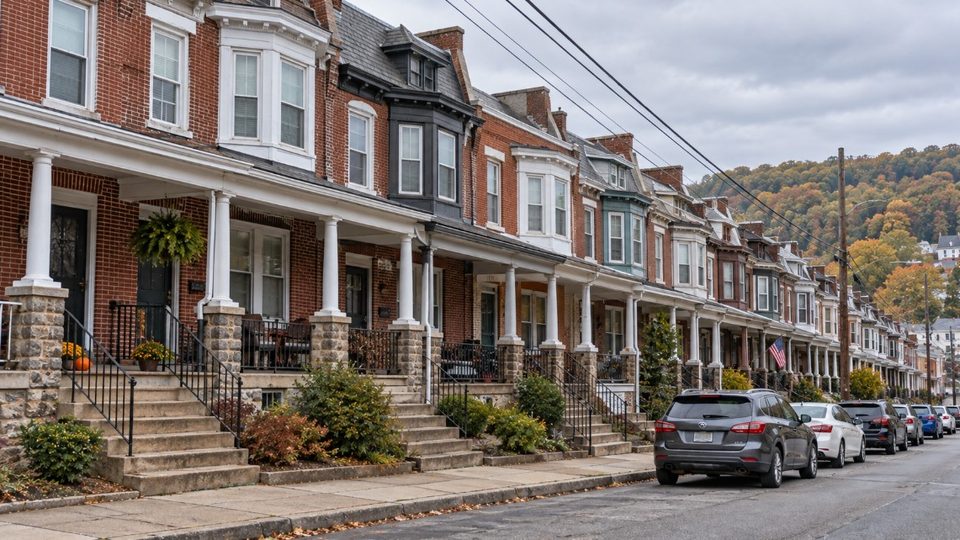
A Small Borough on the Wrong Side of the Flood Line
Bridgeport is a compact borough on the south bank of the Schuylkill, directly across the river from Norristown and bordering Upper Merion. It is a former industrial river town, densely built, with a housing stock that runs heavily to nineteenth and early twentieth century twins and rowhomes on small lots, plus later infill.
Two facts dominate mold work here and they compound each other: much of the borough sits low and close to the river, and much of the housing is old, attached, and built without any of the moisture protections that came later.
The Schuylkill
The Schuylkill gauge at Norristown has flood stage at 13 feet. Its all-time record crest is 25.10 feet, set during Hurricane Agnes in June 1972; Hurricane Floyd brought it to 22 feet in September 1999. On 1 September 2021 the remnants of Hurricane Ida produced catastrophic flooding across southeastern Pennsylvania. The USGS recorded new peak streamflows of record at numerous gauges across the region during that event. Bridgeport was among the communities damaged in that event, along with neighbouring Norristown, and emergency crews closed the bridges between the two boroughs.
The critical point for any property owner here is what riverine floodwater actually is. It is Category 3 — black water. It has passed over roads, through storm drains, past fuel storage and frequently through sanitary sewer systems. The standard of care is unambiguous: everything porous that it contacted comes out. Drywall, insulation, carpet, pad, cabinetry, and anything else that absorbed it. That is not a judgement call.
The scale of the September 2021 event overwhelmed contractor capacity across the region for months. A great deal of work done in that period was fast and incomplete — visible water removed, surfaces cleaned, drywall replaced, but wall cavities never dried to target and no clearance testing performed. Where porous material that contacted Category 3 water was simply covered over rather than removed, the contamination is still in the wall. If your Bridgeport property flooded then and you have persistent musty odour, staining at the base of walls, or a basement that has never smelled right since, that is worth investigating properly.
Twins, Rowhomes and the Party Wall Problem
Attached housing introduces a problem that does not exist in a detached home: a shared masonry wall transmits moisture. A failed downspout next door, an untreated damp cellar on the other side, a leak in a vacant neighbouring property — all migrate through the party wall and appear on your side.
Remediating your side while the source is next door does not hold. And in a borough with a meaningful proportion of rental and absentee-owned property, this becomes a practical and sometimes legal problem rather than a technical one.
If you suspect the source is next door, the sequence that actually works is: get an inspection that documents the moisture gradient increasing toward the party wall; put your findings in writing to the neighbour or the landlord; if the property is a rental, Pennsylvania’s implied warranty of habitability gives the tenants a route to compel their landlord to act; and if it is vacant or bank-owned, borough code enforcement is the correct channel. A documented report opens that conversation far better than a complaint does.
Old Housing, Old Systems
- Cellars with no damp-proof course. Stone and early block foundations in permanent capillary contact with the ground. Constant dampness at the base of the wall, efflorescence, and worse near the river where the water table is higher.
- Galvanised supply and cast-iron drain piping. Original to a great many homes here and decades past service life. Galvanised perforates from internal corrosion; cast-iron stacks corrode at the base of the run and leak into cellars for years.
- Plaster on wood lath. The plaster tolerates brief wetting better than drywall; the wood lath behind it does not, and the cavity is hard to access.
- Flat and low-slope roofs. Common on rowhome stock and unforgiving of any drainage failure. Ponding water finds every seam.
- Shared and party-wall drainage. Downspouts discharging into shared alleys or against foundations, and gutters that are nobody’s clear responsibility.
- Basement conversions. Where a cellar has been finished as living space or a rental unit, often without any moisture strategy at all. Combined with flood exposure this is the highest-risk configuration in the borough.
Sump Systems and Backup Power
In a low-lying borough this is not optional equipment. A mains-powered sump pump is useless during a power cut, and in this region the power cuts and the heavy rain arrive together. A battery backup or water-powered backup pump is one of the highest-value purchases available to a property owner here. So is a sealed pit cover, a functioning check valve, and a discharge line that carries water genuinely away from the building rather than depositing it beside the foundation where it returns.
Insurance, Specifically
Standard homeowners policies in Pennsylvania do not cover surface flooding — a river leaving its banks. That requires separate National Flood Insurance Program coverage, and in Bridgeport that is a genuine consideration rather than a theoretical one. Check whether your property is in a mapped flood zone.
Two further gaps matter here: sump pump failure and sewer backup are typically excluded from a standard policy and are both widely available as inexpensive endorsements. Given the flood and groundwater profile of this borough, reading your declarations page now rather than after an event is worth the ten minutes.
What We Get Called About Most in Bridgeport
Ranked by how often it comes up, and tied to the buildings that are actually here rather than to mold in general.
- Post-flood work that was never finishedThe months after 1 September 2021 overwhelmed contractor capacity. A great deal of work then was water out, surfaces cleaned, new drywall up — with cavities never dried to target and no clearance testing. Riverine water is Category 3; covering it over does not resolve it.
- Sump pump failureThe most frequent single emergency call in a low-lying borough. A mains-only pump is useless in the power cut that arrives with the storm.
- Party wall moisture from an adjoining propertyDense attached housing plus a meaningful share of rental and absentee-owned property. Remediating your side while the source is next door does not hold.
- Cellars with no damp-proof courseWorse here than on higher ground, because the water table near the river is shallow and the masonry is in permanent capillary contact with it.
- Original galvanised and cast-iron pipingCommon in this stock and decades past service life — the leading concealed source in pre-1950 housing.
Neighborhoods and Sections We Cover in Bridgeport
Mold Services Available in Bridgeport
Mold Inspection
Thermal imaging and moisture metering to locate the source before anything is opened up.
DetailsBasement Mold Removal
The dominant mold problem in Bridgeport — finished walls, stone foundations and sump failures.
DetailsBlack Mold Removal
Full containment for water-damage indicator species, plus finding the sustained water source.
DetailsAttic Mold Removal
Sheathing and rafter growth traced back to ventilation, bath fans or ice damming.
DetailsWater Damage & Flood Mold
Burst pipes, sump failures and flooding — the 24 to 48 hour response window.
DetailsClearance Testing
Independent verification by a hygienist who did not perform the remediation.
DetailsWhat Mold Work Costs in Bridgeport
General market ranges for the Greater Philadelphia area, listed for the situations that actually come up in Bridgeport. These are planning figures rather than quotes — nobody can price a job they have not seen, and what moves a number most is the size of the wet area rather than the stained area. The full cost guide explains what drives each one up or down.
| Work | Typical range | Notes |
|---|---|---|
| Mold inspection with thermal imaging and moisture metering | $300–$700 | Most projects should start here |
| Emergency extraction and structural drying | $1,500–$5,000 | Within 24 hours this usually prevents the job above |
| Post-flood remediation, Category 3 water in living space | $8,000–$25,000+ | All contacted porous material must be removed |
| Unfinished basement clean, treat and dehumidify | $1,500–$5,000 | Where there is no finished wall assembly to remove |
| Party wall investigation and documentation | $300–$700 | The inspection report is what opens the conversation next door |
| Sump pump replacement with battery or water-powered backup | $800–$2,500 | The highest-value preventive spend in a low-lying property |
| Lead and asbestos testing before demolition (pre-1978 building) | $400–$1,200 | Far cheaper in advance than discovered mid-job |
| Independent post-remediation clearance testing | $350–$700 | The only stage that produces evidence rather than assurance |
Mold FAQ — Bridgeport, PA
Yes, and it is common enough that we still take these calls. Riverine floodwater is Category 3 — the standard of care requires removing all porous material it contacted. The scale of the 1 September 2021 event overwhelmed contractor capacity for months, and a lot of work done then was incomplete: water removed, surfaces cleaned, new drywall hung, but cavities never dried to target and no clearance testing done. Where contaminated material was covered over rather than removed, it is still there. Signs worth taking seriously: persistent musty odour, staining or a wavy line at the base of walls, soft baseboards, or a basement that has never smelled right since. An inspection with moisture metering and cavity sampling will settle it.
A shared party wall does transmit moisture, so this is technically plausible and we see it regularly in Bridgeport. Practically it becomes a neighbour and legal question rather than a construction one. Start by documenting your side properly: an inspection report with moisture readings showing the gradient increasing toward the party wall is the evidence you need. Then put it in writing. If the neighbouring property is a rental, Pennsylvania's implied warranty of habitability gives those tenants a route to compel their landlord. If it is owner-occupied, a report is a far better opening than a conversation over the fence. If it is vacant or bank-owned, contact Bridgeport Borough code enforcement.
No. Standard Pennsylvania homeowners policies exclude surface flooding — a river leaving its banks or rain overwhelming the ground. That requires separate National Flood Insurance Program coverage, and in a low-lying borough directly on the Schuylkill it is worth serious consideration. Two other gaps matter here: sump pump failure and sewer backup are typically excluded from a standard policy and both are available as inexpensive endorsements. Given the flood and groundwater profile of Bridgeport, check your declarations page now rather than discovering the gap after an event.
General market ranges for this area: a small contained area, roughly $600 to $1,800. A cellar remediation in an older home, roughly $3,000 to $9,000. Post-flood remediation where Category 3 water reached living space, commonly $8,000 to $25,000 because all contacted porous material must be removed. Inspection roughly $300 to $700. Pre-1978 buildings may also need lead and asbestos testing before demolition, roughly $400 to $1,200. Where a covered peril caused the loss, much of this may be claimable — though flood specifically requires NFIP coverage. Planning ranges, not quotes.
Three things, in order of value. First, add a backup — either battery or water-powered. A mains pump is useless in a power cut, and around here the outage and the storm arrive together. Second, check the check valve: a failed one lets the discharge column run back into the pit, so the pump cycles continuously until it burns out. Third, look at where the discharge line ends. If it deposits water within a few feet of the foundation, the same water simply returns to the pit and you are pumping in a circle. While you are at it, fit a sealed pit cover, which reduces both humidity and radon entry from the pit.