Why These Two Belong in the Same Conversation
Radon and mold are different problems with different causes and different health profiles. They end up in the same conversation for one practical reason: they use the same entry paths, and they are both fixed in the same place.
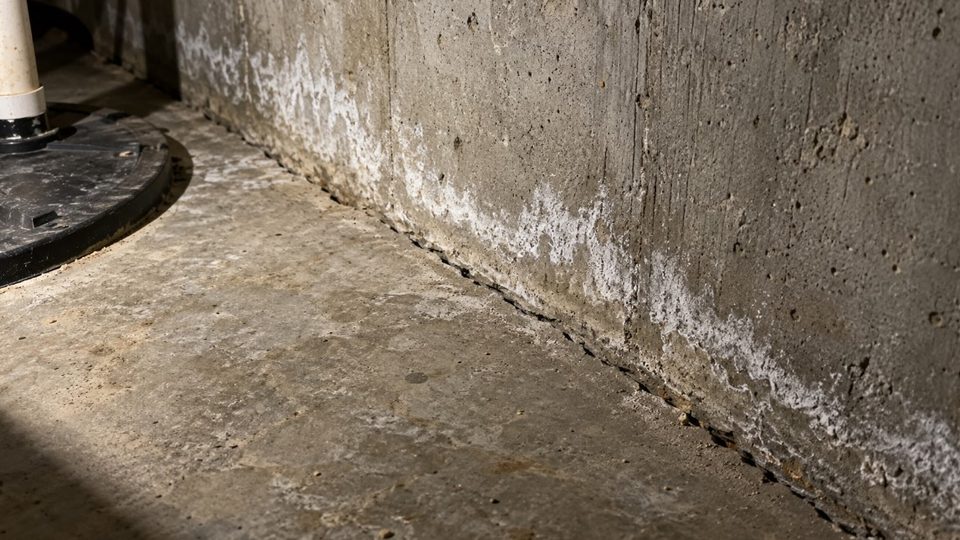
Both enter a building through the slab-to-wall joint, through slab cracks and construction joints, around utility and plumbing penetrations, and through an open sump pit. Sealing work and sub-slab depressurisation done for radon frequently reduce moisture entry as a side effect. Drainage and sealing work done for moisture frequently reduce radon. And if you are already opening up a basement, doing both at once is considerably cheaper than doing them separately.
There is also a sharp and useful contrast between them that every Pennsylvania property owner should know.
One Is Regulated Here. The Other Is Not.
| Mold | Radon | |
|---|---|---|
| PA state licensing | None. No board, no exam, no register. | Yes. PA DEP certifies radon testers and mitigators. |
| Numerical action level | None exists, federally or in PA | 4 pCi/L — the EPA action level |
| How you verify a contractor | Entirely on you — insurance, IICRC, PA HIC | Check DEP certification |
| Measurement | Comparative — indoor vs outdoor control | Absolute — a number against a threshold |
| Testing cost | $300–$600 for an air package | Short-term kit for a few tens of dollars |
This is worth internalising if you are hiring for basement work. When someone tells you they are a “certified mold remediation specialist”, that certification is voluntary and may refer to a weekend course. When someone tells you they are a DEP-certified radon mitigator, that is a state credential you can check.
Radon in Montgomery and Chester County
Southeastern Pennsylvania has genuinely elevated radon potential, arising from the region’s geology. Montgomery County includes the Reading Prong corridor through its northern and central sections; Chester County has Piedmont crystalline basement geology with elevated uranium concentrations in the gneissic and schistose formations. Reading Prong counties have some of the highest residential radon flux rates in the eastern United States.
The headline figure: roughly 40 percent of Pennsylvania homes tested come back above the EPA action level of 4 pCi/L. That is among the highest rates in the country, and it means a test is not a formality here — the base rate is high enough that a positive result should not surprise you.
Two things worth knowing. Radon levels vary enormously between adjacent houses on the same street, because they depend on the specific soil and rock beneath the building, the construction, and how the building is ventilated. Your neighbour’s result tells you nothing about yours. And levels vary seasonally — typically higher in winter, when the house is closed up and the stack effect is strongest — which is why testing protocols specify conditions.
Testing: Cheap, and Worth Doing
Radon testing is genuinely inexpensive and straightforward, which is unusual for anything in this field.
Short-term tests — charcoal canisters or similar, typically deployed for two to seven days — cost a few tens of dollars and are available from hardware stores and the Pennsylvania DEP. They are a screening tool. Because levels fluctuate, a short-term result near the action level warrants a follow-up.
Long-term tests — alpha track detectors deployed for 90 days to a year — give a much better picture of your actual average exposure, which is what matters for health. If a short-term test comes back anywhere near 4 pCi/L, a long-term test is the sensible next step.
Closed-house conditions matter for short-term testing: windows and exterior doors closed except for normal entry and exit, for twelve hours before and throughout the test. Place the detector in the lowest lived-in level, away from drafts, exterior walls and humidity sources.
For a real estate transaction, use a DEP-certified tester rather than a DIY kit. The result needs to be defensible.
How Mitigation Works, and Why It Helps Moisture Too
The standard method is active sub-slab depressurisation. A suction point is cut through the basement slab, a pipe run from it up through the building or along the exterior to above the roofline, and a continuously running fan installed in that pipe.
The fan creates a slight negative pressure in the gravel and soil beneath the slab, lower than the pressure inside the house. Soil gas — which carries the radon — is drawn into the pipe and exhausted above the roof rather than seeping up through the slab into the basement.
The moisture benefit is a genuine side effect rather than a marketing claim. That soil gas is typically saturated with water vapour. Drawing it out from beneath the slab and exhausting it outdoors removes a continuous source of moisture that would otherwise enter the basement. Properly installed systems also require sealing of slab cracks, the slab-to-wall joint and the sump pit, all of which reduce moisture entry directly.
An open sump pit is a direct opening into the soil beneath your basement. It admits radon-bearing soil gas continuously, and it admits water vapour from the standing water in the pit — which then condenses on your cold foundation walls. A sealed, gasketed cover with a proper pump access port costs very little and addresses both. If you have an open pit, this is one of the easiest improvements available.
The Sensible Order If You Are Doing Both
- Test for radon now, before anything elseIt is cheap and it takes days. Knowing the number changes what you do next, and doing it before work starts gives you a baseline.
- Fix bulk water firstExterior grading, downspout discharge, and any drainage correction. This is the foundation of all basement work and it makes everything downstream more effective.
- Remediate any existing moldWhile the space is open and before you seal anything permanently.
- Seal the slab and the sump togetherSlab cracks, the slab-to-wall joint, utility penetrations and a gasketed sump cover. This work counts for both problems and it is genuinely wasteful to do twice.
- Install radon mitigation if the test warrants itUse a PA DEP-certified mitigator. Ask for a post-mitigation test to confirm the system works — this is standard and should be included.
- Then dehumidify and finishPermanent dehumidification to 45–50%, and if you are finishing the space, use the assembly that does not fail: rigid foam against the masonry, framing in front of it, paperless board, no carpet pad on the slab.
- Retest radon afterwardsAny work that changes the airtightness or ventilation of a basement can change radon levels. A follow-up test after finishing is cheap and closes the loop.
One Honest Caveat
Sealing a basement for moisture control can, in principle, raise radon concentrations, because you have reduced air exchange in the space where radon accumulates. This is not a reason to avoid moisture control — it is a reason to test.
The same applies to crawl space encapsulation, which is excellent for moisture and changes the airflow regime beneath the house substantially. If you encapsulate a crawl space, test for radon afterwards. A properly designed encapsulation can actually make subsequent radon mitigation more effective, because the sealed membrane becomes part of the sub-membrane depressurisation system — but you need the measurement to know where you stand.
Radon information here is general. The Pennsylvania Department of Environmental Protection Radon Division is the authoritative source for Pennsylvania requirements, certified professional listings and current guidance.
Questions This Article Raises Most Often
No, and it is worth being clear about because the two get conflated. A dehumidifier removes water vapour from air already in the basement; radon is a soil gas entering through the slab and the wall joint, and lowering the humidity does nothing to it. Some sealing work does help both — a gasketed sump cover and sealed slab cracks reduce radon entry and the moisture that comes with soil gas. But if your radon test comes back above the action level, the answer is a sub-slab depressurisation system, not a bigger dehumidifier.
General market ranges for southeastern Pennsylvania: a standard active sub-slab depressurisation system in a typical single-family home, roughly $1,200 to $2,500 installed. More complex installations — multiple suction points, a large or subdivided slab, a crawl space requiring sub-membrane depressurisation, or awkward routing for the exhaust stack — commonly $2,500 to $4,500. Testing itself is inexpensive: a short-term kit costs a few tens of dollars, and a professional test typically $150 to $300. Planning figures, not quotes.
It can change the levels either way, which is why you test afterwards. Sealing reduces air exchange in the space, which can raise the concentration; but a properly installed reinforced membrane also becomes an effective barrier and makes any subsequent sub-membrane depressurisation system work considerably better. The sensible order is: test before, encapsulate properly, test again afterwards. If the post-work reading is above the action level, the encapsulation you have just paid for makes mitigation cheaper and more effective than it would otherwise have been.
Known radon test results and any mitigation system are the kind of information that falls within the seller disclosure framework, and a mitigation system is visible to any buyer's inspector in any case. Practically, a documented system is not a negative in this market — in an area with elevated radon potential, a house with a tested and mitigated result is often easier to sell than one with no test at all, because it removes an unknown. Keep the original test results, the installation paperwork and the post-mitigation test with the deed.