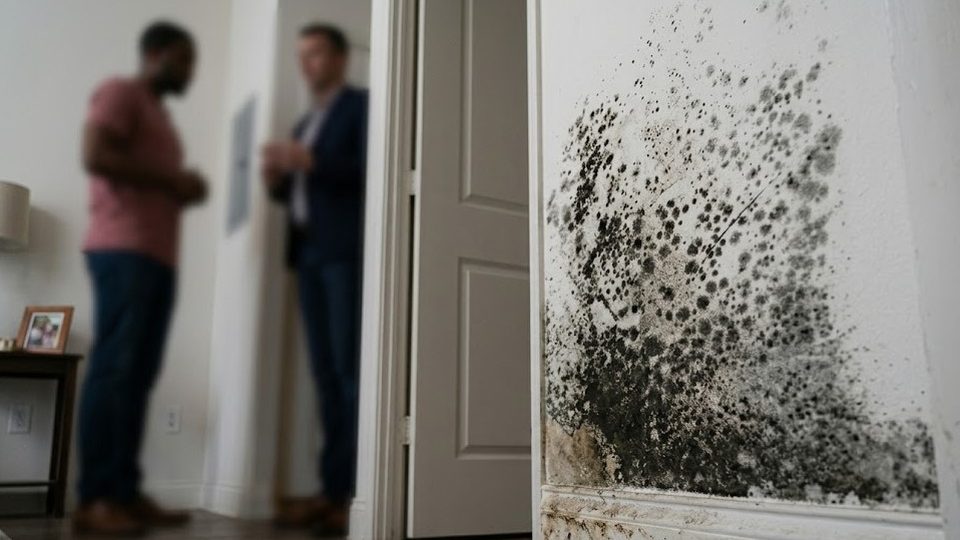
There Is No Mold Statute in Pennsylvania
Pennsylvania has no law that specifically addresses mold in rental housing. There is no mandated remediation standard, no inspection requirement, no disclosure obligation to tenants, and no dedicated enforcement agency.
What applies instead is the implied warranty of habitability, a doctrine established in Pennsylvania case law, which holds that a residential landlord must maintain the rental in a condition fit for human habitation. This warranty is implied into every residential lease in the Commonwealth and cannot be waived by a lease clause purporting to do so.
Significant water intrusion and mold growth have been treated as habitability matters. The threshold is not any mold at all — some fungal presence is normal in every building. The question is whether the condition renders the dwelling unfit, which turns on extent, on whether it affects habitable areas, and on whether it is causing harm.
For Tenants: The Sequence That Works
- Give written notice, and keep a copyEmail is fine and is easier to prove than a letter. Describe the condition factually: where it is, how large, when it started, whether there is a smell, and any water event you know of. Ask for a specific response. Verbal complaints are close to worthless in a dispute — and landlords frequently and genuinely do not recall them.
- Photograph and date everythingWide shots showing the room and the location, close shots showing the condition, and something in frame for scale. Photograph any water source. Keep the originals with their metadata rather than screenshots.
- Keep a logEvery call, every text, every visit, every promise, with dates. This log is frequently the most persuasive document in a habitability dispute because it shows a pattern of delay.
- Give a reasonable time to respondWhat is reasonable depends on severity. Active water intrusion is days. A modest patch of growth is longer. Courts look at whether the landlord acted reasonably, and so should you.
- Consider an independent inspectionAt your own cost, typically $300–$700. This converts your opinion into evidence with numeric readings and a stated cause. In a serious dispute it is usually money well spent.
- Escalate to code enforcementMunicipal code enforcement — Norristown, Bridgeport, Conshohocken, Lansdale, Royersford and most boroughs have an office — has authority over property maintenance and can inspect and issue violations. This is free and it creates an official record.
- Get advice before withholding anythingSee the warning below. This is the step where tenants most often damage their own position.
This is the single most damaging mistake a tenant can make, and it is completely understandable. Pennsylvania law provides remedies including rent escrow — paying rent into an escrow account rather than to the landlord — and in some circumstances repair-and-deduct. But these have specific procedural requirements, and simply withholding rent without following the correct procedure is grounds for eviction. A tenant with a completely valid habitability complaint can lose their home by getting the procedure wrong. Speak to a Pennsylvania attorney or a legal aid organisation before withholding anything. Montgomery County has legal aid services for tenants who cannot afford private counsel.
What to Ask the Landlord For
Be specific. A request to “do something about the mold” invites a bottle of bleach and a wipe. What you actually want, and what a reasonable landlord should provide:
- Identification and correction of the water source. This is the part that determines whether it comes back. Cleaning without it is cosmetic.
- Removal rather than treatment of contaminated porous material. Wet drywall, insulation and carpet pad come out. A biocide sprayed on them does not make them safe.
- Containment during the work, so the rest of the unit is not contaminated.
- Written documentation of what was done.
- Alternative accommodation if the work makes the unit uninhabitable, or if a household member is immunocompromised, pregnant, an infant or has significant asthma.
For Landlords: What Actually Creates Liability
Having seen a fair number of these disputes from the outside, one pattern is consistent: landlords rarely lose because of the mold. They lose because of documented delay and undocumented work.
- Respond in writing, the same dayEven if only to acknowledge and schedule. A written acknowledgement within hours transforms the record, and it costs nothing. Silence is what builds a case against you.
- Inspect promptly and document the conditionDated photographs of what you actually found. If the complaint is exaggerated, your photographs are the evidence of that — but only if you took them.
- Get an independent assessment for anything beyond trivialAn inspection report with readings protects you as much as the tenant. It establishes the extent, the cause, and what a reasonable scope is.
- Fix the water source, not just the growthRepeat complaints about the same condition are what turn a manageable situation into a serious one.
- Check the adjoining and surrounding unitsA single complaint is frequently the first symptom of a building-level envelope or ventilation problem. Finding that early is much cheaper than finding it through four separate complaints.
- Keep the complete fileComplaint, acknowledgement, inspection, scope, invoices, clearance. This is what you produce if it escalates.
- Do not retaliatePennsylvania recognises retaliatory eviction as a defence. Serving notice shortly after a habitability complaint is a poor position to be in, whatever the underlying merits.
A Note on Cause That Cuts Both Ways
Not every mold problem in a rental is the landlord’s fault, and pretending otherwise helps nobody.
Genuine tenant-caused conditions exist: never running the bathroom exhaust fan, drying laundry indoors without ventilation, blocking air vents, keeping the heating off to the point of surface condensation, or furniture pushed hard against a cold exterior wall in an unventilated room. These produce real mold, and they are behavioural.
Genuine landlord-responsibility conditions also exist, and they are more common: a bath fan that discharges into the attic or nowhere at all, a fan that does not work, no fan at all, failed exterior drainage, a roof or plumbing leak, a chronically wet cellar, or a unit with no means of ventilation.
The honest test is usually: could a reasonable occupant avoid this condition through normal use of the dwelling as provided? If the unit has no working exhaust fan, the answer is no, and that is a building problem. If the fan works and is never used, that is a different conversation. An independent inspection is what settles it, which is why it is worth having for both parties.
Resources
- Municipal code enforcement. Every borough and township in this area has one. Free, and it creates an official record.
- Montgomery County legal aid services. For tenants who cannot afford private counsel.
- The Pennsylvania Attorney General’s office, for consumer matters relating to contractors.
- A Pennsylvania attorney. For anything where the tenancy or a significant sum is at stake. The procedural requirements around rent escrow in particular are not something to navigate from a web article.
This article describes Pennsylvania landlord-tenant principles in general terms and is not legal advice. The implied warranty of habitability, rent escrow and repair-and-deduct all have specific requirements established in case law, and outcomes are fact-specific. Consult a Pennsylvania attorney or a legal aid organisation about your situation before taking action that affects your tenancy.
Questions This Article Raises Most Often
Not lawfully as a reprisal. Pennsylvania recognises retaliatory eviction as a defence, so a notice served shortly after a documented habitability complaint is a weak position for a landlord. That said, the practical protection depends entirely on your record: a written complaint with a date, kept copies, and a log of communications is what makes retaliation demonstrable. A verbal complaint leaves you with nothing to point at. If you receive a notice after complaining, speak to a Pennsylvania attorney or legal aid promptly rather than waiting.
Generally your own renter's insurance is the first place to look, and it is worth checking whether your policy excludes mold, as many do. A landlord may be liable where the damage resulted from their failure to repair a condition you had reported, which again turns on your written record. Photograph damaged items, keep them if it is safe to do so, and note purchase dates and values. If the amount is significant and the landlord's negligence is documented, small claims court is a realistic route in Pennsylvania without needing a lawyer.
Possibly, under the doctrine of constructive eviction, where a condition is severe enough to make the unit genuinely unfit and the landlord has failed to remedy it after notice. That is a high bar and it is risky to rely on: if a court disagrees you remain liable for the rent. The safer path is written notice, a documented opportunity to repair, an independent inspection if you can afford one, and advice from a Pennsylvania attorney or legal aid before you move out. Leaving first and arguing afterwards is the version that goes badly.
No. Paint over active growth on a damp surface hides it for a few months and changes nothing about the cause; mold-resistant paint resists colonisation of the film itself, not of the substrate behind it. Document it — photograph before and after, note the date — and put in writing that the moisture source has not been identified or corrected and that you expect it to recur. That record matters, because when it does reappear you will be able to show a pattern of inadequate response rather than starting from scratch.