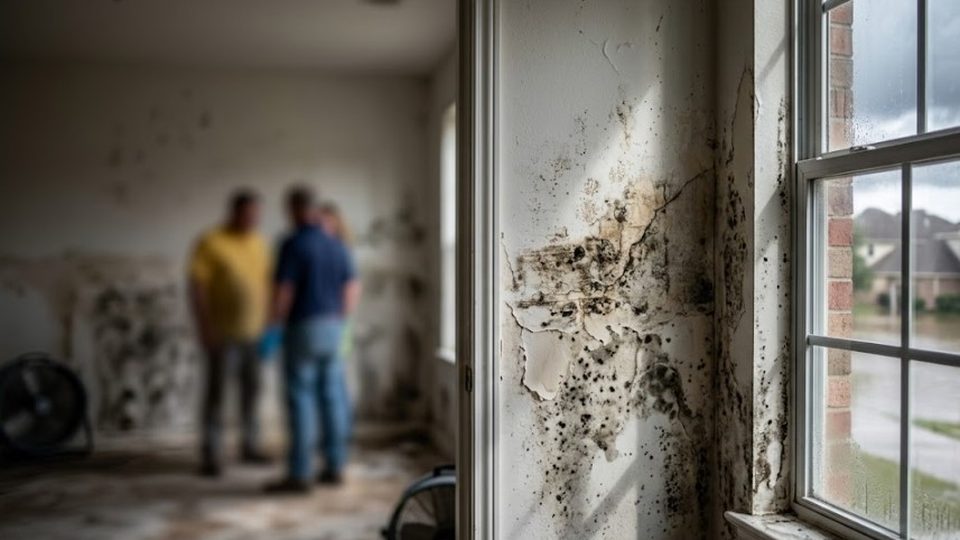
Most of These Are Not Visible Mold
If you can see mold, you do not need a list. The useful signs are the ones that indicate a problem you cannot see — which in Montgomery County housing is most of them, because the dominant mechanisms here happen inside closed assemblies.
Work through these room by room. None of them on its own proves anything. Two or three together is worth investigating.
1. A persistent musty or earthy smell
The strongest single indicator, and the most commonly dismissed. That odour is microbial volatile organic compounds, produced by living, actively growing colonies. It is not a residue, not old building smell, not “what basements smell like”. Something in that space is wet enough to support growth right now.
Notice whether it is stronger when a space has been closed up, and whether it is seasonal — worse in July and better in January points to summer condensation behind a wall.
2. Dampness that is worse in summer than winter
Counter-intuitive and highly diagnostic. A buried foundation wall sits at 52–58°F year round; summer dew points here reach the low 70s. Air at that dew point condenses on that wall. If your basement is damp in July and dry in January, you are looking at condensation, not a leak — and the fix is entirely different.
3. A wavy line or soft spot at the bottom of the drywall
Run your hand along the bottom twelve inches of every basement wall and press. Gypsum board that has taken on water and dried in place deforms subtly. Softness, a bulge, a slight horizontal undulation, or baseboard that no longer sits flat means that material was wet.
4. Baseboard separating or soft to the thumb
Press firmly along the bottom of the baseboard. It should be rigid. Softness, or trim that has pulled away from the wall, indicates moisture in the wall base.
5. White crystalline bloom on masonry
Efflorescence — mineral salts deposited as water evaporates out of the wall. It is not mold (how to tell them apart): it brushes off dry and dissolves in water. But it is direct physical proof that liquid water is moving through that masonry, which is the precondition for everything else here. Note where it is heaviest; that is where water is entering.
6. Staining or dampness at the rim joist
The band of framing sitting on top of the foundation wall, usually holding a fiberglass batt. Pull a batt back and look. It is the coldest wood in the building in winter and a prime condensation surface in summer, and almost nobody inspects it. Dark staining on the wood, or damp compressed insulation, is a finding.
7. Dripping cold water pipes in summer
Uninsulated cold supply lines in a humid basement condense and drip continuously through July and August, onto whatever is below them. Twenty dollars of foam pipe insulation fixes it. If you are seeing this, the basement humidity is high enough that the walls are doing the same thing.
8. Dark staining on attic sheathing
Go up with a torch and look at the underside of the roof deck, particularly on the north-facing plane which stays coldest. Read the pattern: a distinct dark cone above a bathroom means the bath fan discharges into the attic; general staining worst near the ridge means blocked soffit venting; staining concentrated at the eaves means ice damming. Rust or frost on the nail points means active condensation.
9. A kneewall access hatch nobody has opened
If the upstairs rooms have sloped ceilings meeting a short vertical wall, there is a triangular void behind it. Open the hatch and look. In postwar Capes across Upper Merion this is one of the most reliably contaminated spaces in the building, precisely because it is never inspected.
10. A ceiling stain that appears in late spring
On the top floor, near an exterior wall, with no roof defect above it. That is the delayed signature of ice dam water that entered in February and took until June to migrate to the surface. Homeowners consistently call roofers in July and find nothing wrong — because there is nothing wrong with the roof.
11. A musty smell only in the first minutes after the HVAC starts
Highly diagnostic. The first push of air carries accumulated microbial VOCs off a wet, stationary evaporator coil into the house before steady airflow dilutes them. If the smell is also equally strong in every room, that confirms distribution through the system rather than a local source. Have the coil, drain pan and drain line looked at directly — cabinet open, not a torch at a vent.
12. Anything soft under a sink or behind an appliance
Open every sink base cabinet and press the deck. Look behind the toilet at the closet flange, under the dishwasher, at the washing machine box, and in the water heater pan. Slow drips in closed cabinets run for months, and particleboard cabinet decks swell and delaminate before anything reaches the floor.
13. Rust on fixings, hinges and electrical boxes near floor level
Corrosion is a slow integrator: it does not tell you about a single event, it tells you the area has been humid for a long time. Rust on basement door hinges, on shelf brackets, or inside an electrical box near the floor is evidence of sustained elevated humidity.
14. Cardboard that has gone soft on the basement floor
A free moisture meter. Cardboard absorbs from the slab and from the air. If the bottom of a box that has sat on the concrete for a year is soft, wavy or discoloured, the slab is damp or the humidity is high. Which also means the box itself is now a growth substrate — get everything organic off the floor and away from the walls.
A hygrometer in the basement and one on the main floor, read across a few weeks in different weather. Sustained readings above 55% in the basement in summer tell you the surfaces are condensing. And an infrared thermometer to read the actual surface temperature of the foundation wall — if it is colder than the dew point of the room air, that wall is condensing water right now. Together the two cost less than a restaurant meal and will tell you more about your house than most paid opinions.
What to Do If Several of These Apply
- Do not disturb anything visibleNo scrubbing, sanding or spraying, and do not point a fan at it. Disturbing growth aerosolises it and converts a contained problem into a distributed one.
- Do the free diagnosticsCheck gutters, downspout discharge and grading. Physically trace where every bath fan and dryer duct terminates. Put a hygrometer in the basement.
- Note the patternSeasonal or rain-correlated or constant? Localised or across a whole wall? This single observation narrows the cause more than any instrument.
- Then callDescribe what you found. In a good number of cases the honest answer is that the fix is a downspout extension and a dehumidifier, and you will get that answer.
Questions This Article Raises Most Often
For mold, no — the retail settle-plate kits will grow colonies from any indoor air in any building, because normal air contains viable spores, and they have no calibrated volume and no outdoor control. For the two measurements that actually matter, yes and they are cheap: a hygrometer tells you the relative humidity, and an infrared thermometer tells you the surface temperature of a wall, which together tell you whether that surface is condensing. A radon short-term test kit is also a genuine, standardised home test and costs very little.
Three. Active water intrusion of any kind, because the clock on mold growth is 24 to 48 hours. A ceiling stain that is growing or a ceiling that feels soft, because saturated drywall overhead is a collapse risk as well as a mold one. And a musty smell that appeared suddenly rather than gradually, which suggests something has recently changed — a pipe, a drain, a failed sump. The rest are worth investigating on a sensible timetable rather than the same day.
Ask what they measured. A visual opinion that a space looks fine is not the same as moisture readings at named locations, a thermal scan, and a dew point calculation against surface temperature. If they measured nothing, the opinion is worth what it cost. Get an inspection from someone who does not perform remediation, and ask specifically for numeric moisture readings. If they did measure and the numbers are normal, that is genuinely reassuring — ask for the figures in writing and keep them as a baseline to compare against next year.
Yes, and that is worth being honest about. Growth inside a closed wall cavity with no odour path to the room, in an attic nobody has entered, or under a floor can be entirely silent for years. That is precisely why the two high-risk categories in this region — a finished basement built the conventional way, and a property with a past water event that was never verified — are worth inspecting on the basis of their history rather than waiting for a symptom.