Five, Not Fifty
There is no shortage of mold prevention lists. Most of them are thirty items long, undifferentiated, and include things that make almost no measurable difference in this climate alongside things that make an enormous one.
These are the five with the highest effect per dollar in King of Prussia housing specifically. If you do nothing else, do these. The complete seasonal system is here if you want the full version.
1. Get the Roof Water Away From the Building
Cost: nothing to a few hundred dollars. Effect: larger than anything else on this list.
A typical roof sheds a startling volume of water in a storm — thousands of litres from a single inch of rain on an average house. All of it arrives at four or five downspouts. Where those downspouts discharge determines whether that water leaves your property or soaks into the ground beside your foundation.
Three things to check today:
- Gutters clear and actually flowing. Look during rain, not on a dry day. Overflowing gutters dump water directly against the wall.
- Downspouts discharging at least six feet from the foundation, and ideally ten. A splash block at the base of the wall is not a discharge; it is a delay. Use rigid extensions or buried solid pipe carrying water to daylight.
- Grading falling away for the first ten feet. Ground that sloped away when the house was built has very commonly settled over forty years so that it now falls toward it. Check with a level on a long board, or simply watch where puddles form.
This single item resolves a meaningful share of the basement moisture complaints we hear about. It is also the one thing every reputable contractor will tell you to do before they sell you anything else — and the absence of that advice tells you something about the contractor.
2. Close the Basement in Summer and Dehumidify Mechanically
Cost: $200–$500 for a decent unit plus installation. Effect: eliminates the region’s commonest mold mechanism.
A buried foundation wall here sits at 52–58°F year round. From June to September, outdoor dew points run in the mid-60s to low 70s°F. Humid air reaching that cold wall condenses on it. No leak required. This is the largest single cause of basement mold in Montgomery County.
The intuitive response — opening the windows to air it out — makes it worse, because you are importing the humid air that is doing the condensing. The correct approach:
- Keep basement windows shut from roughly June through September.
- Size the dehumidifier properly. A small consumer unit in a 1,200 square foot basement will run continuously and never reach setpoint.
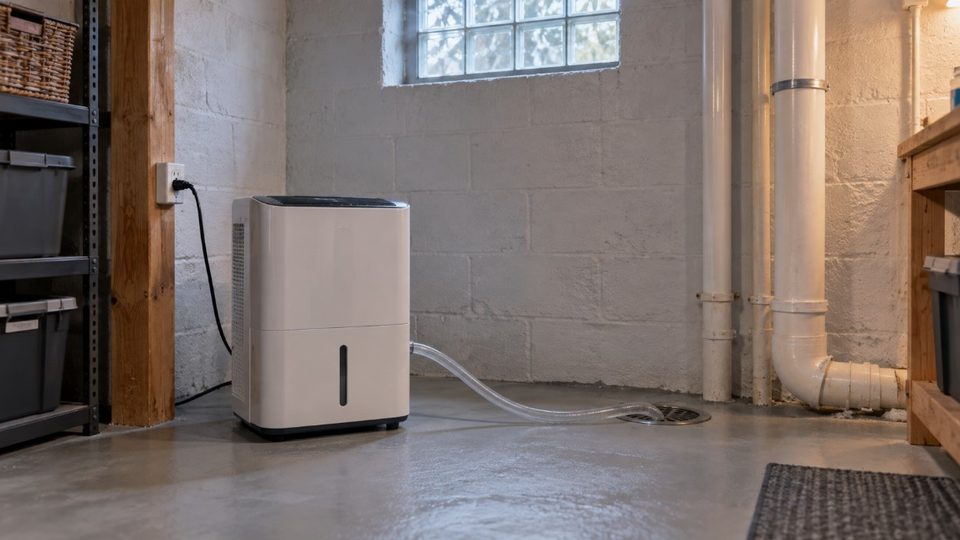
- Plumb it to a drain — the sump, a floor drain, or a condensate pump. The commonest failure of any dehumidifier is a bucket that stops being emptied in September.
- Set it to 45–50%, not 60%. At 60% room humidity, surfaces cooler than the room are still condensing.
- Leave it running through the shoulder seasons — April, May and October, when heating and cooling are both off and nothing else is controlling humidity.
3. Verify Every Exhaust Fan Actually Terminates Outside
Cost: nothing to check. $400–$1,200 per fan to correct. Effect: eliminates one of the top attic mold causes here.
Go into the attic with a torch and physically follow every duct. Bath fans, kitchen hood, dryer. In a great many local homes, particularly unmodernised postwar housing, at least one of them ends in the attic rather than outside — either by original design, or because a flexible duct fell off its termination, or because it was crushed under blown-in insulation.
A bath fan discharging into an attic delivers several litres of shower water a week directly at cold roof sheathing. A dryer duct does considerably more. The signature is a distinct dark cone of staining on the sheathing directly above the room in question.
While you are up there: check whether the soffit vents are blocked by insulation, which is extremely common after an energy upgrade and makes attic ventilation ineffective. Full detail in go into your attic and follow the bath fan duct.
4. Air-Seal and Insulate the Rim Joist
Cost: $1,000–$3,500 professionally, or a capable DIY weekend. Effect: high, and almost nobody does it.
The rim joist — also called the band joist — is the horizontal band of framing that sits on top of the foundation wall, around the whole perimeter of the house. In pre-1980 homes it is typically bare; in later ones it holds a fiberglass batt pushed into the bay with nothing sealing it.
It is simultaneously the coldest wood in the building in winter and a prime condensation surface in summer, and it is one of the largest air leakage paths in the whole house. A fiberglass batt does nothing useful there, because fiberglass does not stop air — humid air moves straight through it to the cold wood behind, and condenses.
The correct treatment is closed-cell spray foam, or carefully cut and sealed rigid foam board. It is a contained, well-defined job, it pays back in heating costs as well as moisture control, and it is genuinely the most under-appreciated item on this list.
5. Get Everything Organic Off the Basement Floor and Away From the Walls
Cost: an afternoon and some plastic bins. Effect: disproportionate.
Even with good humidity control, growth needs a food source. In a typical basement, the food source is everything people store there: cardboard boxes, paper, books, wooden shelving in contact with the masonry, old carpet and matting, textiles, and upholstered furniture.
Cardboard in particular is both a substrate and a moisture sponge — it absorbs from the slab and from the air, and the bottom of a box that has sat on concrete for a year is frequently soft. That box is now a colony.
The fix costs almost nothing:
- Plastic bins with lids instead of cardboard
- Metal or plastic shelving, not wood, held clear of the walls so air can move behind
- Nothing directly on the slab — everything up on shelving or pallets
- No old carpet, matting or upholstered furniture below grade
- Nothing stacked against the foundation wall, which creates a still, saturated boundary layer exactly where growth starts
Items 1 and 5 are essentially free. Item 2 is a few hundred dollars. Item 3 is free to check and modest to fix. Item 4 is the largest expense and the one most worth paying for. Against the cost of remediating a failed finished basement — commonly $5,000 to $15,000 before reconstruction — the whole programme is inexpensive insurance.
And One Thing That Is Not a Technique
Buy a hygrometer. Put one in the basement and one on the main floor. Read them across a few weeks in different weather.
It costs less than a takeaway meal and it converts everything above from guesswork into management. You will know whether your dehumidifier is actually reaching setpoint, whether the shoulder seasons are a problem in your house, and whether anything you have done has made a difference. You cannot manage what you have not measured.
Questions This Article Raises Most Often
The exterior water, every time — and it is the cheapest. Clearing gutters, extending every downspout to discharge at least six feet from the foundation, and correcting grading that has settled to fall toward the house costs very little and frequently resolves a basement moisture complaint on its own. It is also the one that every reputable contractor will tell you to do before selling you anything else, which is a useful way to judge a contractor.
Two easy methods. Put a long straight board against the foundation running outward, rest a level on it, and check the fall — you want roughly six inches of drop over the first ten feet. Or simply watch during heavy rain and see where water goes and where it pools. Common culprits are mulch beds built up over the years until they sit above the siding line, patios and driveways that have settled toward the house, and downspout extensions removed by a landscaper and never replaced.
Cut-and-cobble with rigid foam board is within reach of a capable DIY homeowner: cut the board to fit each bay, seal the perimeter with canned spray foam, and work methodically around the whole house. It is tedious rather than difficult. Two cautions: the work must not block combustion air for any atmospherically vented furnace or water heater, and building codes generally require foam to be covered by a thermal or ignition barrier in certain situations, so check what applies locally. Closed-cell spray foam gives a better result but is a professional job.
Some of them, and one in particular. New construction usually has properly detailed foundation waterproofing and correct grading at handover, so the exterior items matter less at first — though grading settles and downspout extensions go missing within a few years, so they are worth re-checking. The item that matters most in a new house is the opposite of the old-house list: new envelopes are very tight, so verifying that the bathroom and kitchen exhausts work and are actually used, and that any ERV or HRV is switched on, is where the risk sits.